How Much Does Google Ads Management Cost in 2026?
Ask five Google Ads managers what they charge and you'll get five different answers, three of which change once you're on the phone with them. I publish my prices. Here's how the pricing actually works, what everyone else is really charging, and where to watch your wallet.

Pricing in this industry is opaque by design. Most agencies won't put a number on a page. Most freelancers quote differently depending on how the discovery call goes. That's not always malicious, every account is different, but it also means prospective clients have no anchor for what's reasonable. You end up comparing a $2,000 quote to a $6,000 quote with no idea what either buys you, and picking based on who sounded more confident on the call.
Google Ads management cost is typically structured as a percentage of monthly ad spend (10-20%), a flat monthly fee, or a hybrid of both, with freelancers generally landing lower than agencies for comparable senior-level attention. The number that matters more than the pricing model is what's actually included: how often the account gets touched, who's doing the work, and whether tracking and reporting are part of the fee or billed as extras.
The Three Pricing Models You'll Run Into
Almost every quote you get will fall into one of three buckets. Each has a real logic behind it, and each has a way it can go wrong for you.
| Model | How it works | Where it goes wrong |
|---|---|---|
| Percentage of spend | You pay a fixed percentage of what you spend on ads each month | Gets expensive fast at high spend levels with no matching increase in effort |
| Flat fee | A fixed monthly rate regardless of budget | Can undervalue complex accounts, or get padded with a vague scope |
| Hybrid | A smaller base fee plus a percentage on top | Harder to compare quotes since two numbers move independently |
Percentage of spend
This is the most common model, and it makes sense on paper: as your budget grows, the manager's fee grows with it, so incentives are supposedly aligned. In practice, the honest version of this model has a minimum fee attached, because a 15% cut of a $3,000 budget doesn't cover a competent person's time. The dishonest version has no minimum, and no cap either, so once you're spending $80,000/month, you're paying $12,000-$16,000/month for work that doesn't scale linearly with budget. Bid management on a mature account at $80K/month isn't ten times harder than the same account at $8K/month.
Flat fee
A flat fee is predictable, and it removes the awkward feeling of paying more just because your budget went up. The honest version scopes the fee to account complexity: number of campaigns, conversion actions, markets, and how much hands-on optimization the account needs. The dishonest version quotes a low flat fee to win the deal, then either lets the account go on autopilot or tries to upsell you into add-ons for work that should have been included from the start.
Hybrid
A hybrid, a lower base fee plus a smaller percentage, tries to split the difference. It works when both numbers are disclosed clearly and the base fee actually reflects a floor on effort, not just a psychological anchor to make the percentage look small. It's harder to comparison-shop because you're comparing two moving numbers instead of one, so ask for the all-in monthly total at your current spend level, not just the formula.
Stop guessing with your ad spend.
I build highly profitable Google Ads acquisition systems for ambitious brands. Stop burning cash on broad match and let's scale your ROAS properly.
What Agencies, Freelancers, and In-House Teams Actually Charge
I won't invent numbers I can't stand behind, so I'll say this in plain terms instead of fake precision. Agencies generally charge more than freelancers for comparable work, and the reason is straightforward: agency pricing has to cover office overhead, account managers, sales staff, and often a layer of people between you and whoever actually touches your campaigns. That overhead doesn't disappear, it gets built into your invoice.
Freelancers and independent specialists typically price lower for the same or better hands-on attention, because there's no organizational layer to fund. The tradeoff is capacity: one person can only manage so many accounts well, which is exactly why a serious freelancer should have a minimum spend or minimum fee and a cap on how many clients they take.
In-house is a different equation entirely. You're not paying a management fee, you're paying a salary plus benefits, plus whatever tools and platform access that person needs (bid management software, reporting tools, sometimes a data analyst to support them). For a business running one or two accounts at meaningful scale, in-house can make sense. For most businesses running a single account, it's a lot of fixed cost for one person's judgment, with no backup if they leave. I wrote more about how to evaluate this tradeoff in my guide to hiring a Google Ads expert, including what to ask before you commit to any of the three.
What I Charge and Why
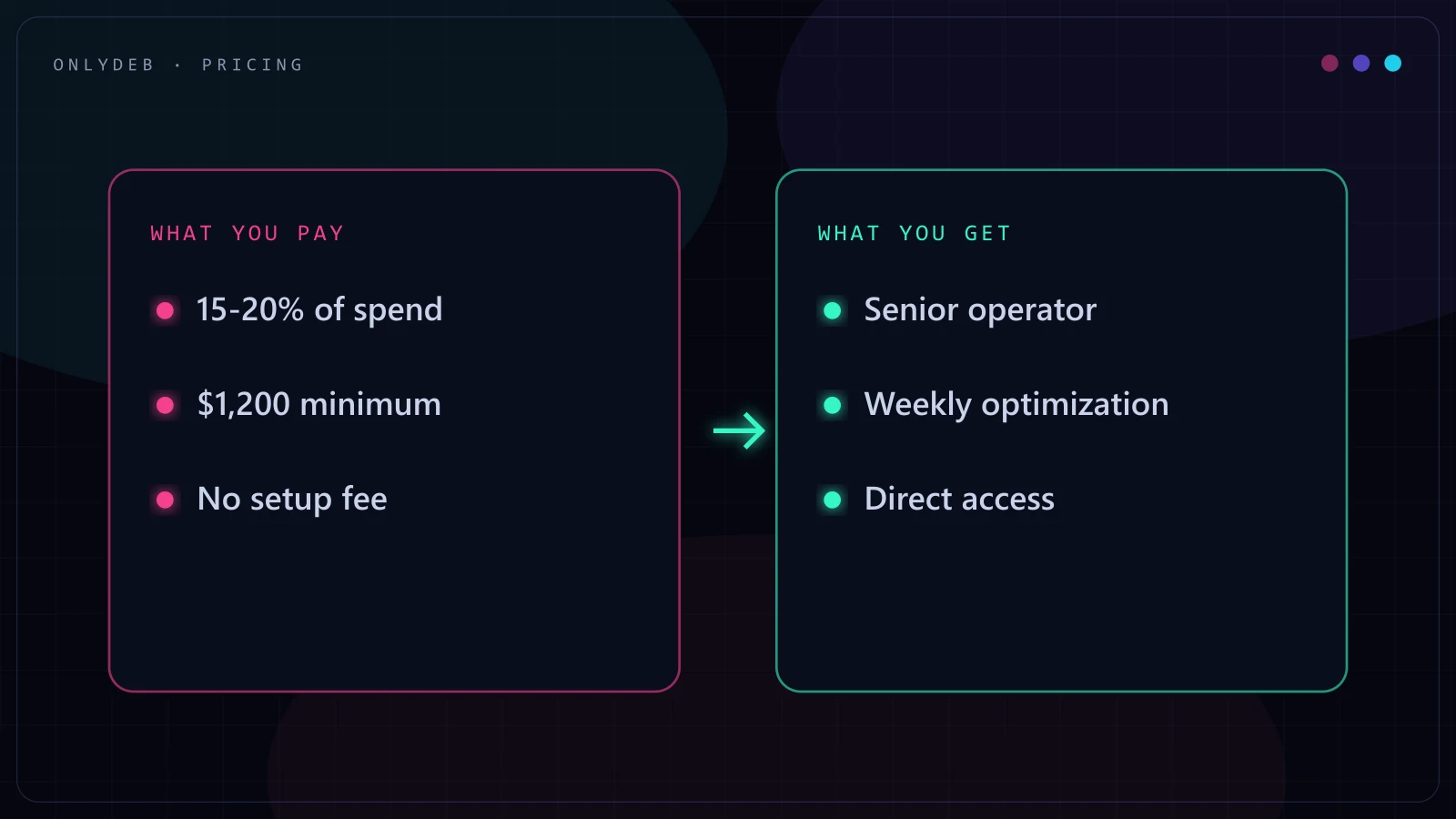
I price at 15-20% of monthly ad spend, with a $1,200/month minimum, no setup fee, and a 3-month minimum commitment billed monthly after that. Here's the reasoning behind each piece.
- 15-20% of spend: This scales with the account, but the range narrows as spend grows, since the work per dollar drops as an account matures.
- $1,200/month minimum: Below a certain spend level, the account can't support real weekly attention at any reasonable percentage. The minimum exists so I'm not stretched too thin across too many small accounts.
- $0 setup fee: Conversion tracking, initial structure, and audits are part of onboarding an account responsibly. Charging extra for the bare minimum required to do the job is a markup on due diligence, not a legitimate fee.
- 3-month minimum: Google Ads needs a learning period after real changes. A month-to-month arrangement with no floor invites clients to judge results before the algorithm has caught up, and invites managers to chase quick wins instead of durable ones.
What's included: weekly optimization and reporting, a monthly strategy call, direct access to me via Slack or email (not a shared inbox or a project manager relaying messages), and conversion tracking setup from day one.
That background is also why I don't compete on being the cheapest option. I've managed a client at $300K+/month spend down to a sub-$8 CPA, and helped another go 5x on signups at $100K+/month spend. Pricing reflects the fact that the work behind those numbers is hands-on, not templated.
Red Flags in Pricing
Some pricing patterns are worth walking away from regardless of the headline number.
Management Fees vs Wasted Spend
The comparison that actually matters isn't "cheap management" versus "expensive management." It's management fees versus wasted ad spend. A badly run account bleeds money in ways that never show up as a line-item invoice: broad match keywords burning budget on irrelevant searches, Performance Max cannibalizing branded traffic that would have converted for free, stale audiences, tracking that double-counts or under-counts conversions so every decision after that is built on bad data.
The cheapest manager and the most expensive wasted budget are often the same account.
A $1,500/month fee on a $10,000/month budget is 15%. A poorly optimized account wasting 25-30% of that same budget on irrelevant clicks and bad targeting costs you more than the fee itself, and you don't see it on an invoice, you see it as flat growth and a CPA that never improves. When you're evaluating cost, ask what the account is actually spending on badly right now, and whether the fee you're comparing against a competitor's lower quote buys you someone who'll fix that or someone who'll leave it running.
If you want a broader framework for vetting who you hire, not just what they charge, I go through it in my guide to hiring a performance marketing consultant.
FAQ
What is a typical Google Ads management fee percentage?
Percentage-of-spend pricing usually falls somewhere between 10% and 20% of monthly ad spend, though the exact number depends on account size and how much hands-on work the account needs. Smaller accounts tend to sit at the higher end of that range because a flat percentage on a small budget barely covers the manager's time.
Is percentage of spend or flat fee pricing better?
Neither model is inherently better. Percentage of spend aligns incentives as your budget grows but can get expensive at large spend levels. Flat fee is predictable and doesn't penalize you for scaling budget, but it can undervalue the work on a genuinely complex account. A hybrid, a flat base plus a smaller percentage, usually balances the two.
What minimum ad budget makes Google Ads management worth it?
If your monthly ad spend is well below your management fee, you're paying more to manage the account than you're spending to run it, and that math rarely works. Most managers, including me, set a monthly minimum for exactly this reason. Below that line, a well-documented DIY approach or an in-house hire usually makes more sense than outside management.
Are setup fees normal?
Setup fees exist across the industry, but they are not universal, and a large one for basic account structure and conversion tracking is worth questioning. That work is part of the job, not a separate project. I charge $0 for setup because conversion tracking and initial build are baseline requirements to manage an account responsibly, not an upsell.
What does Deb charge?
I charge 15-20% of monthly ad spend with a $1,200/month minimum, no setup fee, and a 3-month minimum commitment billed monthly. That includes weekly optimization and reporting, a monthly strategy call, direct Slack and email access to me, and conversion tracking setup as part of onboarding, not an add-on.
If you've read this far, you already know more about how this pricing works than most people quoting it to you. If you want to see whether my numbers make sense for your budget, or just want a second opinion on a quote you've already got, get in touch and let's talk about your account.