Hire Google Ads Expert: Your Vetting Guide for 2026
I once reviewed an account where the invoice said 'senior strategist' but the change log showed a junior media buyer touching bids between four other clients' accounts. That gap between who sells the contract and who actually manages your money is the whole hiring problem. Here's how to close it before you sign anything.

Hiring a Google Ads expert means finding a specialist who will manage your campaigns daily with senior-level attention, transparent reporting, and verifiable case studies proving real ROAS results in your industry. The average business wastes 3-6 months and $10,000-$30,000 in ad spend before discovering their "expert" is actually a junior account manager following a checklist.
I saw this pattern from the inside for years. At Google's Operations Center I reviewed more than 400 accounts a quarter, and the ones that struggled almost always had the same story: a senior operator closed the deal, then the account got passed to a junior manager, a media buyer with too many clients, or a generalist working off a checklist. You still pay for “expert management.” You just don’t receive it.
When Your Ad Spend Becomes a Guessing Game
The warning sign isn’t always obvious failure. Sometimes the account looks busy. Search terms are coming in. Performance Max is spending. Reports mention CTR, CPC, and conversions. But nobody can explain why one campaign gets budget while another doesn’t, why lead quality dropped, or whether the account is pushing revenue that survives after refunds, churn, or weak close rates.
The expensive part is often invisible
Bad hiring decisions rarely blow up on day one. They erode the budget. The account gets “maintained.” Search queries don’t get cleaned fast enough. Feed issues sit too long. Bid strategy gets changed without enough context. Landing page mismatch gets ignored because it lives outside the ads platform.
That handoff problem matters because Google Ads rewards close attention. Small account decisions compound. Match type discipline, asset group logic, negative keyword hygiene, offer alignment, audience exclusions, tracking checks, and budget shifts all need judgment. A junior operator can follow process. A seasoned expert can tell when the process itself is wrong.
What profitable hiring actually means
- Explain trade-offs clearly: Why Search gets priority over YouTube in one account, or why Shopping should be cleaned before scaling.
- Tie ad decisions to business outcomes: Not just leads, but lead quality, margin, sales velocity, and retention where relevant.
- Stay directly involved: The account shouldn’t disappear into an internal queue after kickoff.
Choosing Your Expert: In-House vs Agency vs Independent
| Model | Best fit | Main risk |
|---|---|---|
| In-house | Brands needing daily internal collaboration | One hire rarely covers every Google Ads discipline well |
| Agency | Teams wanting broader channel support | Senior seller, junior delivery handoffs |
| Independent | Brands wanting direct access and flexibility | Output is limited by one operator’s time |
Stop guessing with your ad spend.
I build highly profitable Google Ads acquisition systems for ambitious brands. Stop burning cash on broad match and let's scale your ROAS properly.
Why independents fit many growth-stage brands
For many e-commerce, SaaS, DTC, and lead gen companies, an independent specialist is the cleanest option because the person you hire is usually the person doing the work. I've managed more than $5 million in combined ad spend this way over 8+ years, and clients still get the same person who scoped the account, not a rotating queue. The feedback loop is shorter. Decisions happen faster.
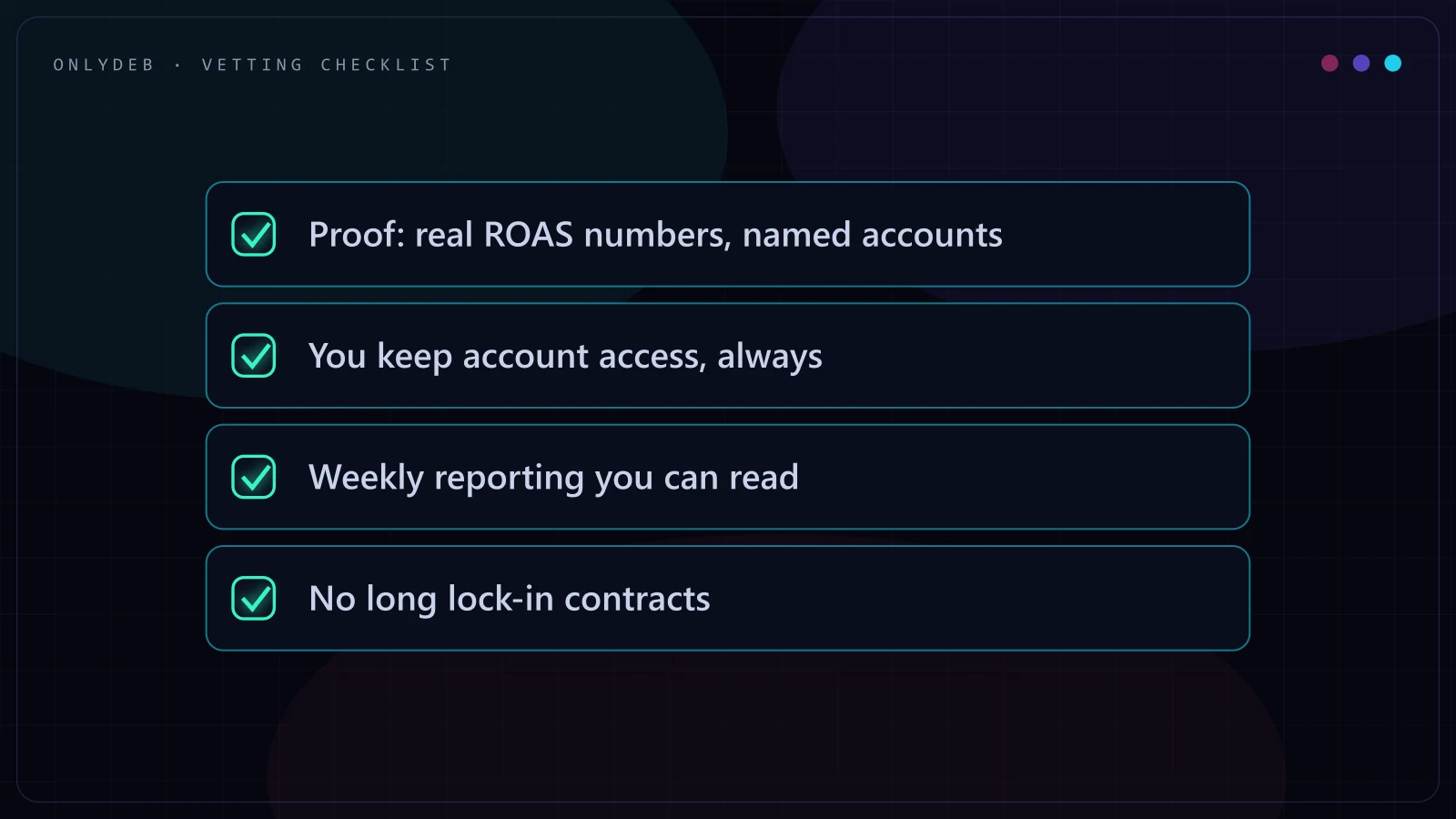
The Ultimate Vetting Checklist Before You Talk
A good pre-call checklist does one job. It filters out polished sellers, overloaded freelancers, and agencies that hide delivery behind process language.
- Relevant case studies: Ask for examples from similar sales cycles.
- Direct account ownership: Ask who will build, review, and optimize the account. Get names.
- Tracking and measurement fluency: They should be able to explain GA4, GTM, offline conversion imports.
Your First 90 Days Onboarding and Setting KPIs
The first 90 days are not a CTR contest. Pick KPIs that reflect how the business makes money:
- Use profit-aware KPIs: Revenue can mislead when margin varies.
- Track CPA with context: Lower CPA is meaningless if lead quality drops.
- Watch POAS where possible: Profit on ad spend is often a better decision metric.