Reduce Customer Acquisition Cost: Your 2026 Playbook
I get some version of this every quarter: ad spend is up, the platform dashboard still says conversions are healthy, and margin keeps getting thinner anyway. By the time someone calls me, they've usually blamed the algorithm for months. It's rarely the algorithm.

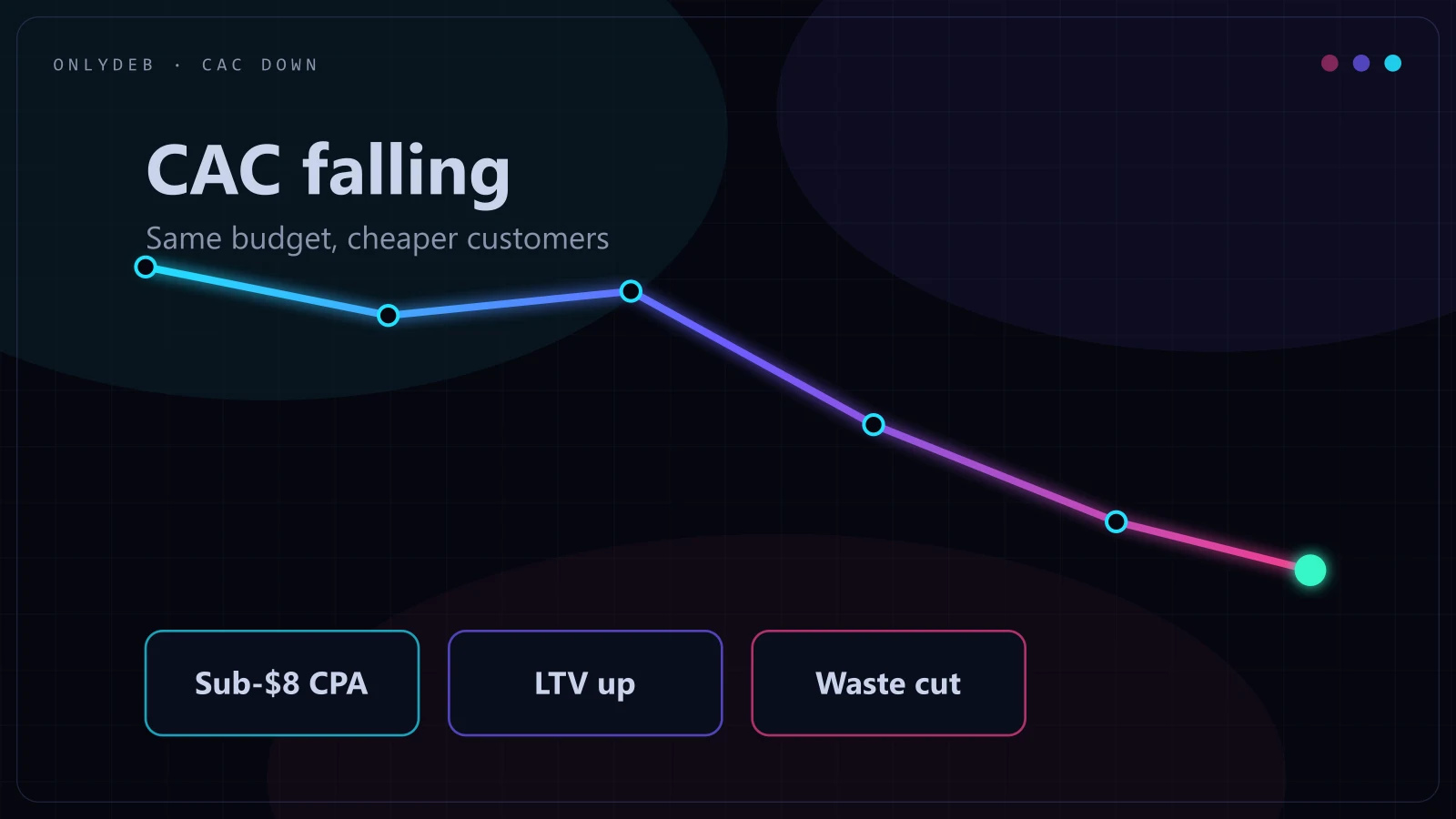
Why Your Customer Acquisition Cost Is Soaring
Customer acquisition cost is what it costs, across media, tools, and team time, to turn a stranger into a paying customer. When it climbs, the cause is rarely just pricier clicks. It is usually a mix of weak measurement, poor optimization signals, and a post-click experience that wastes the demand you already paid for.
Monday morning. The dashboard says CPA is stable. Finance says contribution margin is down. Sales says lead quality slipped again. That is how rising CAC shows up in practice. It rarely starts with one ugly metric inside Google Ads or Meta.
Higher CPMs, more competition, and privacy changes are part of the pressure. Expensive traffic alone isn't the core issue. I saw this on Garage Doors LA, a local lead gen account where daily leads went from 100 to more than 500 without CAC blowing up, because the fixes were in measurement and post-click experience, not just a bigger budget.
Stop guessing with your ad spend.
I build highly profitable Google Ads acquisition systems for ambitious brands. Stop burning cash on broad match and let's scale your ROAS properly.
Conduct a Brutally Honest CAC Diagnosis
A real CAC diagnosis starts outside the ad platforms. Use blended CAC first: total acquisition cost divided by net new customers. On Bloomstories, a subscription audio app running $100,000 or more a month, blended CAC told a very different story than platform CPA once I added in creative production and landing page tools.
Reallocate Your Budget for Maximum Profit
The fix is to reallocate spend based on profit per incremental dollar, not platform-reported efficiency. I used this exact approach on Black Voyage, moving ROAS from 1.69 to 4.26 in four months by shifting spend toward the buckets that actually converted. Start by breaking channels into decision-ready buckets: brand search, non-brand search, Shopping, Performance Max, YouTube, demand gen, and remarketing.
Treat referral as a CAC pressure valve, not a side project
I don't ask paid media to carry the whole acquisition target on its own. Referral can lower blended CAC, especially for products with strong customer satisfaction, and in my experience it works best when tied to a specific customer moment: after a successful onboarding milestone, after a second purchase, or after support resolves an issue well.
Fix Your Leaky Landing Pages and Funnel
I've seen paid media look efficient in-platform and still lose money after the click more times than I can count. The first thing I pull is a landing-page report by campaign, then I trace what actually happens after the click.
- 1. Align message scent: Match the landing-page headline, offer, CTA, and product selection to the ad that drove the click.
- 2. Improve speed and mobile UX: Compress heavy assets, reduce script bloat, and check Core Web Vitals on the actual landing pages tied to spend.
- 3. Shorten the path to conversion: Cut unnecessary fields. Allow guest checkout. Surface shipping costs earlier.
- 4. Tighten tracking: Set up server-side GTM, enhanced conversions, and CRM or offline conversion imports so platforms can optimize toward actual revenue.
Implement a Ruthless Testing and Measurement Roadmap
Reducing CAC is an operating habit, not a project you finish. Most testing programs fail because they try to test everything at once. Build a testing cadence your team can sustain.
| Priority layer | What to test | Why it matters |
|---|---|---|
| Measurement | Attribution logic, CRM matching, server-side tagging | Bad data poisons every later decision |
| Funnel | Landing page copy, form flow, checkout friction | Conversion lift lowers CAC without more spend |
| Creative | Hooks, proof, product angles, CTA framing | Better relevance improves both CTR and CVR |
| Media allocation | Budget shifts, query coverage, exclusions | Strong channels get more capital |