How to Improve Ecommerce Conversion Rate: Full Guide
I've opened accounts where every campaign metric looked healthy and the store still couldn't explain a soft month. The leak wasn't in the auction. It was in the handoff between click and checkout, and almost nobody checks there first.

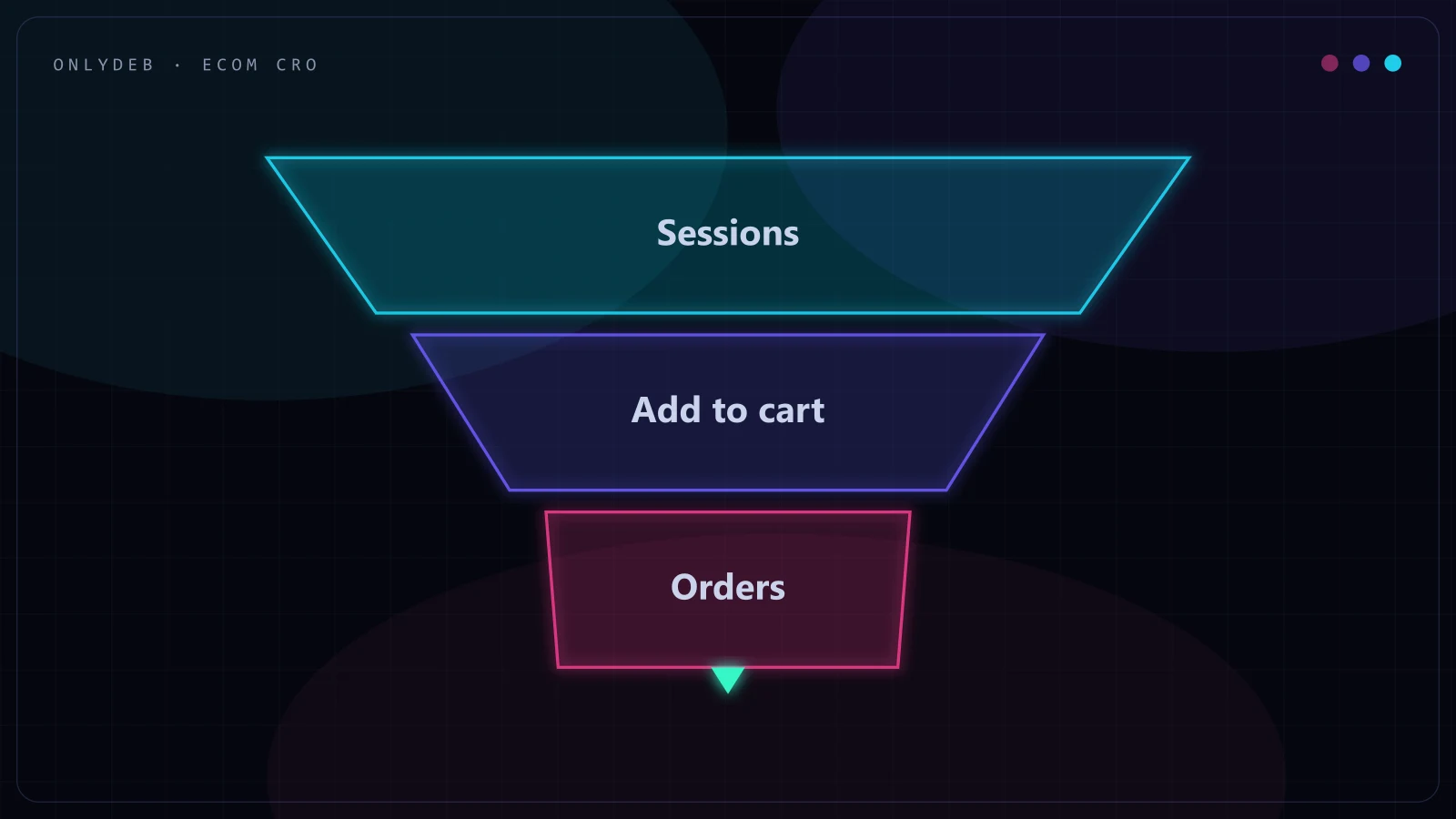
Auditing Your Conversion Funnel for Profit Leaks
I've sat in front of ecommerce accounts where every campaign metric looked healthy and the owner still couldn't explain why revenue wasn't moving. The mistake is rarely in the bidding. It's the assumption that more traffic fixes a leaky funnel, when the leak is what's actually costing the money.
Ecommerce conversion rate optimization is the practice of increasing the share of visitors who complete a purchase, mainly by removing friction on the product page, cart, and checkout rather than buying more traffic. Most stores lose more revenue to a leaky funnel than to weak ad targeting.
CRO starts with diagnosis. On Dagamma, a baby products ecommerce brand spending $300,000 or more a month, I never touched the ad budget until I found where traffic was leaking between click and purchase. A heuristic analysis is one of the fastest ways to spot major conversion blockers.
What to inspect in a heuristic analysis
| Area | What to check | Common leak |
|---|---|---|
| Clarity | Headline, product promise, offer framing | Visitor doesn’t understand the offer quickly |
| Trust | Reviews, policy access, visual proof | Buyer uncertainty stays unresolved |
| Momentum | CTA visibility, page flow, distractions | User gets pulled away before purchase |
Building a Resilient Tracking Infrastructure
If your data is wrong, your optimization is theater. For DTC brands running Google Ads, iOS signal loss and vanity ROAS can distort decisions. Implementing server-side GTM tracking can restore up to 20-30% of lost conversion data. That fix is part of what kept Dagamma's cost per acquisition under $8 even as I scaled the budget past $300,000 a month.
- Product view: Fire when a shopper lands on a PDP.
- Add to cart: Your strongest pre-checkout intent signal.
- Begin checkout: Essential for separating product-page problems from checkout problems.
- Purchase: Deduplicate carefully so the same order doesn’t inflate platform learning.
Stop guessing with your ad spend.
I build highly profitable Google Ads acquisition systems for ambitious brands. Stop burning cash on broad match and let's scale your ROAS properly.
Streamlining the Path to Purchase and A/B Testing
Cart and checkout are where many stores waste the intent they already paid for. A shopper who adds to cart has done the hard part. Your job is to stop introducing new reasons to quit.
What to remove from checkout first
- Forced sign-in: It blocks people who are ready to buy now.
- Unnecessary fields: Every field adds hesitation and error potential.
- Hidden costs: Surprise costs break trust late in the funnel.
- Limited payment methods: Some buyers will leave rather than switch cards or devices.
Aligning Paid Media for Maximum Profit on Ad Spend (POAS)
Platform ROAS is useful, but it is not the final score. It reports revenue against ad spend inside a system that doesn’t fully understand your margins, returning-customer mix, refunds, discounts, or shipping costs. On Dagamma, I tracked POAS instead of ROAS through peak season and helped protect more than $2 million in seasonal revenue. POAS asks a better question: after real costs, did this spend produce profitable growth?