How Much Should You Spend on Google Ads? Budget Planning for 2026
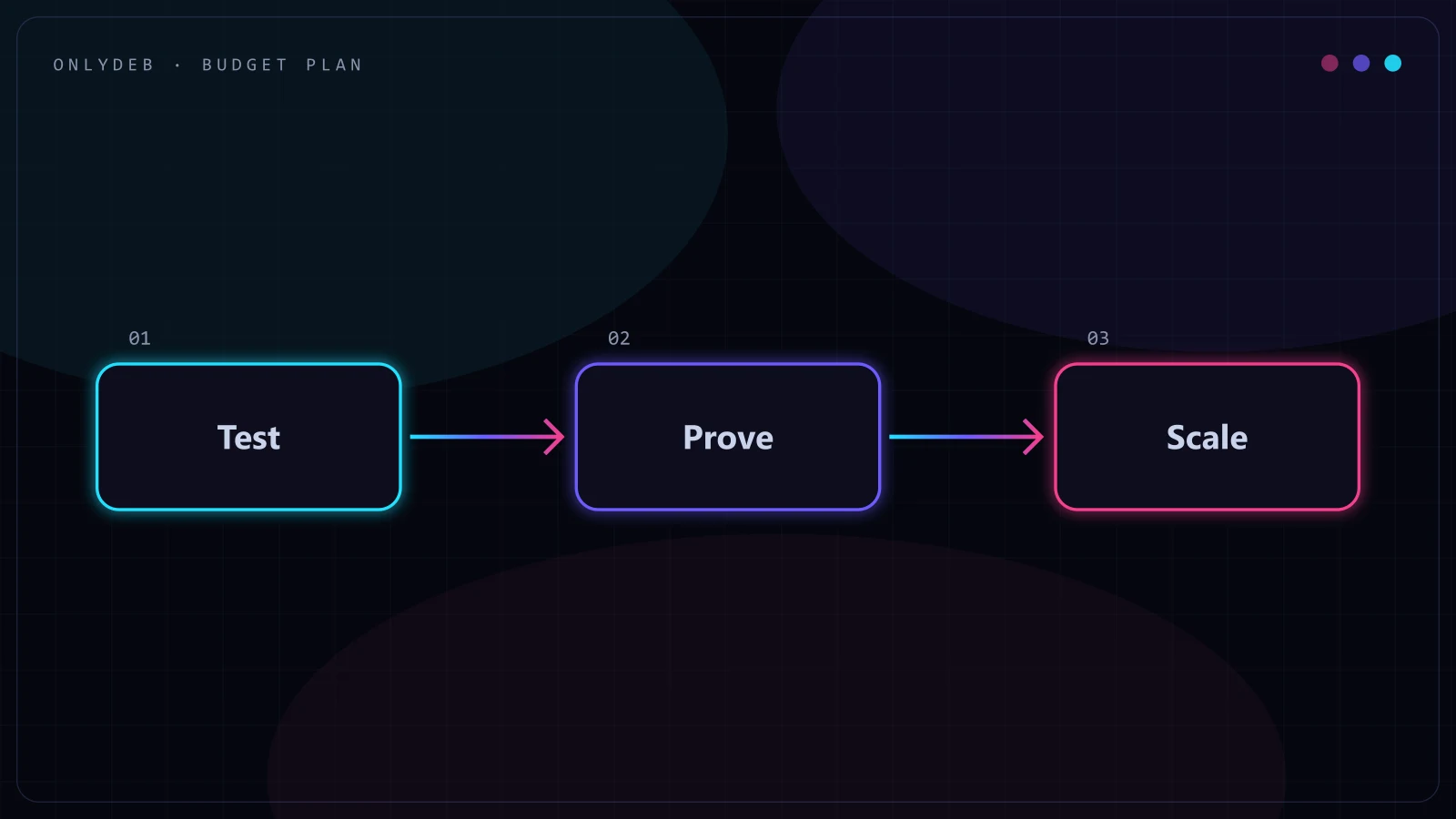
Three-stage budget flow: test, prove, scale

The first question on almost every discovery call is some version of "what should my budget be?" People want a number. I understand why, a number is easy to plan around and easy to compare against a competitor's quote. But the honest answer isn't a number, it's a framework, because I've run this same conversation on accounts spending $5,000 a month and on accounts spending $300,000 a month, and the logic underneath the budget decision hasn't changed once. What changes is the zeros. A business asking whether it can afford $8,000/month and a business asking whether it can afford $80,000/month are asking the exact same question in different currency, and they get the same answer worked out from their own numbers.
A Google Ads budget is a data-buying decision, not a media-buying decision. Every dollar you spend either produces a conversion you can learn from or it doesn't, and the budget's real job is to generate enough of those data points, fast enough, for the account (and you) to tell whether something is working. Set it too low and you're not being careful, you're just buying too little data to ever know.
The Test, Prove, Scale Framework
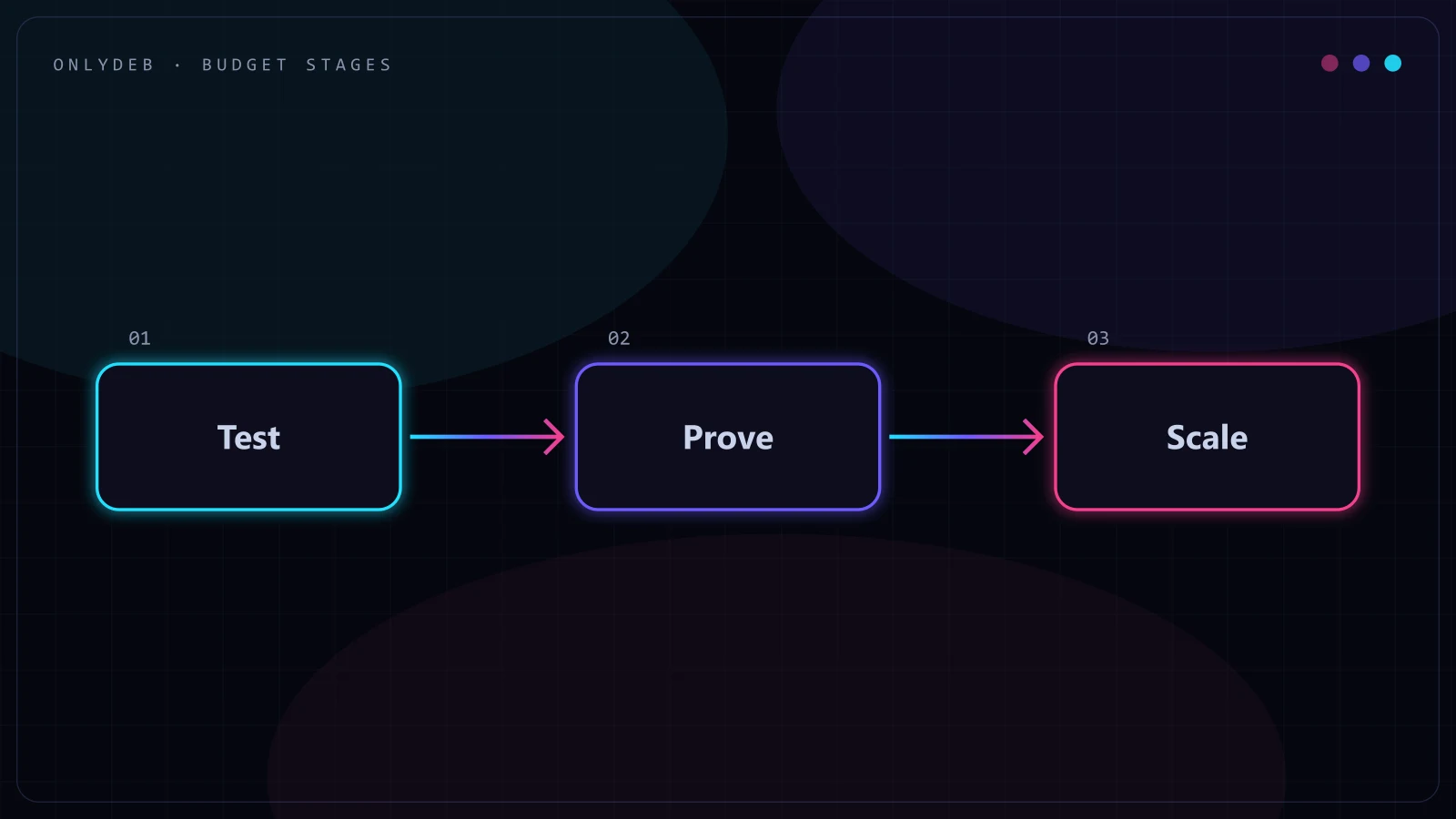
Every account I've run, regardless of size, moves through three budget stages. Skipping one, usually the middle one, is where most budget decisions go wrong.
| Stage | What it's for | Exit condition |
|---|---|---|
| Test | Confirm the offer, landing page, and targeting can convert at all | A handful of real conversions with a plausible, if noisy, CPA |
| Prove | Confirm the CPA holds steady across enough volume to trust it | Stable CPA across several weeks and enough conversions for the bid strategy to have exited learning |
| Scale | Grow spend deliberately against confirmed demand | An ongoing loop, not a finish line, revisited every time you raise budget again |
Test is the smallest, cheapest stage, and its only job is to answer one question: does this offer, on this landing page, in front of this audience, convert at all? You're not optimizing yet. You're finding out whether there's anything here worth optimizing. Budget at this stage should be sized to get you a small number of real conversions within a few weeks, enough to know the account isn't structurally broken.
Prove is where most of the real decision-making happens, and it's also the stage people are most tempted to skip. Proving means running at a steady, sufficient budget long enough to see the CPA hold across multiple weeks, not just one good stretch. A single strong week during test can look like proof and isn't. Proof is a pattern, not a data point.
Scale only starts once you've proved the number. Scaling is deliberate: you raise budget in response to confirmed demand signals (more on those below), you watch the CPA as you do it, and you treat every increase as its own small test of whether the account can absorb more spend at the same efficiency. Scale isn't a reward you get for surviving the first two stages, it's a loop you keep running.
Stop guessing with your ad spend.
I build highly profitable Google Ads acquisition systems for ambitious brands. Stop burning cash on broad match and let's scale your ROAS properly.
The Minimum Viable Budget: Why It's About Conversions, Not Dollars
People ask for a minimum budget in dollars. The real minimum is a minimum number of conversions per month, because that's what the bid strategy actually needs to do its job, and dollars are just the unit that gets you there.
Here's the reasoning, not a formula. Automated bid strategies, tCPA, tROAS, maximize conversions, work by observing conversion outcomes and adjusting bids in response. That process needs a reasonable sample of conversions each month to have signal to learn from. If your account produces only a handful of conversions a month, every one of those conversions carries enormous statistical weight, and the algorithm is effectively making decisions off a small, noisy sample. That is just how learning from data works. Too few data points and the "pattern" you're reacting to might just be noise.
So the minimum viable budget is whatever budget, at your actual cost per conversion, produces enough conversions per month for the system to have something to learn from. If your target CPA is $40, you need a budget that supports a meaningful number of conversions monthly at that CPA, not a budget that produces two or three. If your CPA is $400, the dollar minimum is naturally ten times higher for the same conversion count, because the math doesn't change, only the currency does. This is exactly why a flat "spend at least $X" answer is close to useless without knowing your CPA first. If you're setting a first budget from scratch, my first $1K training simulator walks through this same reasoning with a fictional budget on the line.
How Budget and Bid Strategy Interact
This is the part that trips up accounts that otherwise look fine on paper. A budget and a bid strategy aren't independent settings, they're a single system, and underfunding one breaks the other.
Take a target CPA campaign on a budget too small to hit that target CPA's implied conversion volume. The bid strategy is trying to find bids that produce conversions at your target cost, but it can't gather enough conversion data to converge on a stable bidding pattern, so it oscillates: overspending on some auctions, underspending on others, chasing a target it doesn't have enough evidence to hit reliably. The account looks unstable, CPA swings week to week, and the instinctive response is to blame the bid strategy or switch to manual bidding. Usually the actual problem is upstream: the budget was never large enough to give the target CPA strategy something to learn from in the first place.
I go into the manual-versus-automated side of this in more detail in my piece on automated vs manual bidding, but the budget piece is the part that's easy to miss: an automated bid strategy is only as good as the volume you feed it, and volume is a direct function of budget and CPA together, not either one alone.
Reading the Signals That Say It's Time to Scale
Scaling on a hunch is how good months turn into bad quarters. There are two signals I actually trust, and neither of them is "we had a great week."
The first is lost impression share due to budget. Google Ads reports this directly: it's telling you the account would show up in more auctions, and likely generate more conversions, if the daily budget weren't capping it. When that number is meaningful and has held steady for a while (not a single spike day), it's a direct signal that demand exists beyond what you're currently funding.
The second is conversion volume that keeps rising while CPA stays flat or improves, across multiple weeks. That combination is the closest thing to proof that the account has room to grow without losing efficiency. Volume rising while CPA also rises is a different, more cautious signal, it might still be worth scaling, but it means you're paying more per outcome to do it, which is a tradeoff decision, not a green light.
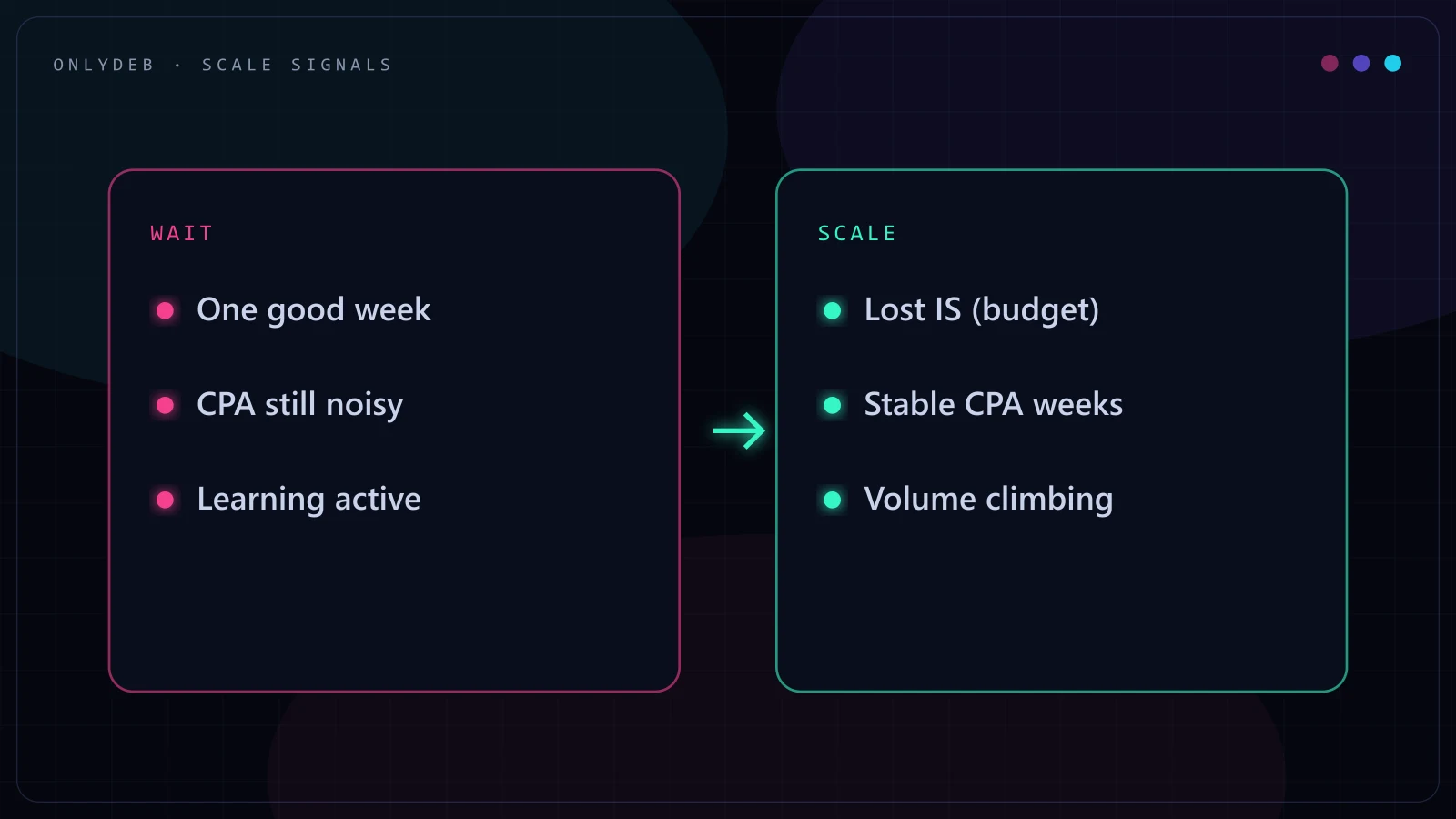
A good week is an anecdote. A good month at rising volume and flat CPA is a signal. Scale on the signal.
Seasonal Budgeting: Planned Aggression, Not Panic Spending
Seasonal peaks are where the test-prove-scale logic gets compressed into a shorter window, and where budget planning either pays off or falls apart. With Dagamma, an account I've run past $300,000/month, the seasonal peaks that pushed past $2M in revenue during peak periods, at a sub-$8 CPA, didn't come from waiting until the peak arrived and then reacting. They came from planning the aggression in advance: knowing which weeks history and the calendar said demand would spike, pre-proving the campaigns and creative that would carry that spike during the lead-up period, and having the budget ceiling already raised and approved before the peak started, not requested mid-peak while impression share was already being lost. My peak season planner lays out that same week-by-week countdown if you're mapping one out.
Panic spending is the opposite pattern: budget gets raised reactively once someone notices the peak is underway, campaigns that haven't been proven at that volume get pushed hard anyway, and the account eats a learning-phase CPA spike exactly when CPA matters most. Planned aggression means the proving happened earlier, off-peak, when a rough week costs little, so that the scale stage during the actual peak is executing against a number you already trust instead of discovering it live.
Budget Mistakes That Waste the Most
Across every account size I've managed, three budget mistakes account for most of the wasted spend I've had to clean up.
Every one of these mistakes comes from treating budget as a lever you pull based on feeling, instead of a resource you allocate based on what stage the account is actually in. Test, prove, scale isn't a slogan, it's a discipline for deciding when to spend more and when to hold, and it works the same whether the account in question is spending $5,000 a month or $300,000.
If pricing and management structure are the other half of this decision for you, I break that down separately in my guide to what Google Ads management actually costs.
FAQ
What is the minimum budget to start Google Ads?
There is no universal minimum, because it depends entirely on your cost per conversion, not on a fixed dollar amount someone quotes you. The real question is whether your budget can produce enough conversions in a month for the bid strategy to learn and for you to read the data with any confidence. If your target cost per acquisition is $50, a $500/month budget gives you roughly ten conversions to learn from, which is not enough. The minimum is the budget that gets you to a meaningful conversion count for your specific numbers, not a number pulled from a blog post.
Should I think about my budget daily or monthly?
Monthly, with daily as the operational unit underneath it. Google Ads campaigns run on daily budgets, but daily performance is noisy: a bad Tuesday means nothing on its own. I evaluate accounts on rolling weekly and monthly windows and let daily spend fluctuate within that envelope. Google already allows daily spend to vary against the daily budget you set, so fighting that day to day just adds stress without adding signal.
When should I increase my Google Ads budget?
Increase when you see scale signals, not when you feel optimistic. The two I look for are lost impression share due to budget (the account is telling you it would spend more if it could) alongside a stable or improving cost per acquisition, and conversion volume that keeps climbing at a steady CPA over several weeks, not a single good day. Increasing budget on a strong single week, before the trend confirms itself, is how accounts get scaled on noise instead of proof.
Does pausing hurt the learning phase?
Yes, meaningfully. Pausing a campaign, or cutting its budget hard, during an active learning period resets progress the bid strategy had already made toward finding its stable conversion rate. The algorithm relearns once the campaign restarts, and that relearning period is where CPAs usually spike. If a campaign is underperforming during learning, the better move is almost always to let it finish the learning window on unchanged settings before judging it, rather than panicking mid-cycle.
Is there a percentage of revenue I should spend on Google Ads?
I don't use a fixed percentage of revenue rule, and I'd be skeptical of anyone who hands you one without knowing your margins, your customer lifetime value, or your current CPA. A business with high margins and repeat customers can rationally spend a much larger share of revenue acquiring a customer than a low-margin, one-time-purchase business can. Budget should come from what a customer is worth to you and what it currently costs to acquire one, not from a rule of thumb borrowed from a different business model.
If you're trying to figure out what your account's actual minimum viable budget is, or whether you're ready to scale, get in touch and let's work through your numbers together.