Google Ads for SaaS and Subscription Businesses: The 5x Sign-ups Playbook
A monthly sign-up chart that finally bends up doesn't mean the account is healthy, it means someone checked the wrong number too early. Here's how I ran Google Ads for a $100K+/month subscription business without falling for that trap.

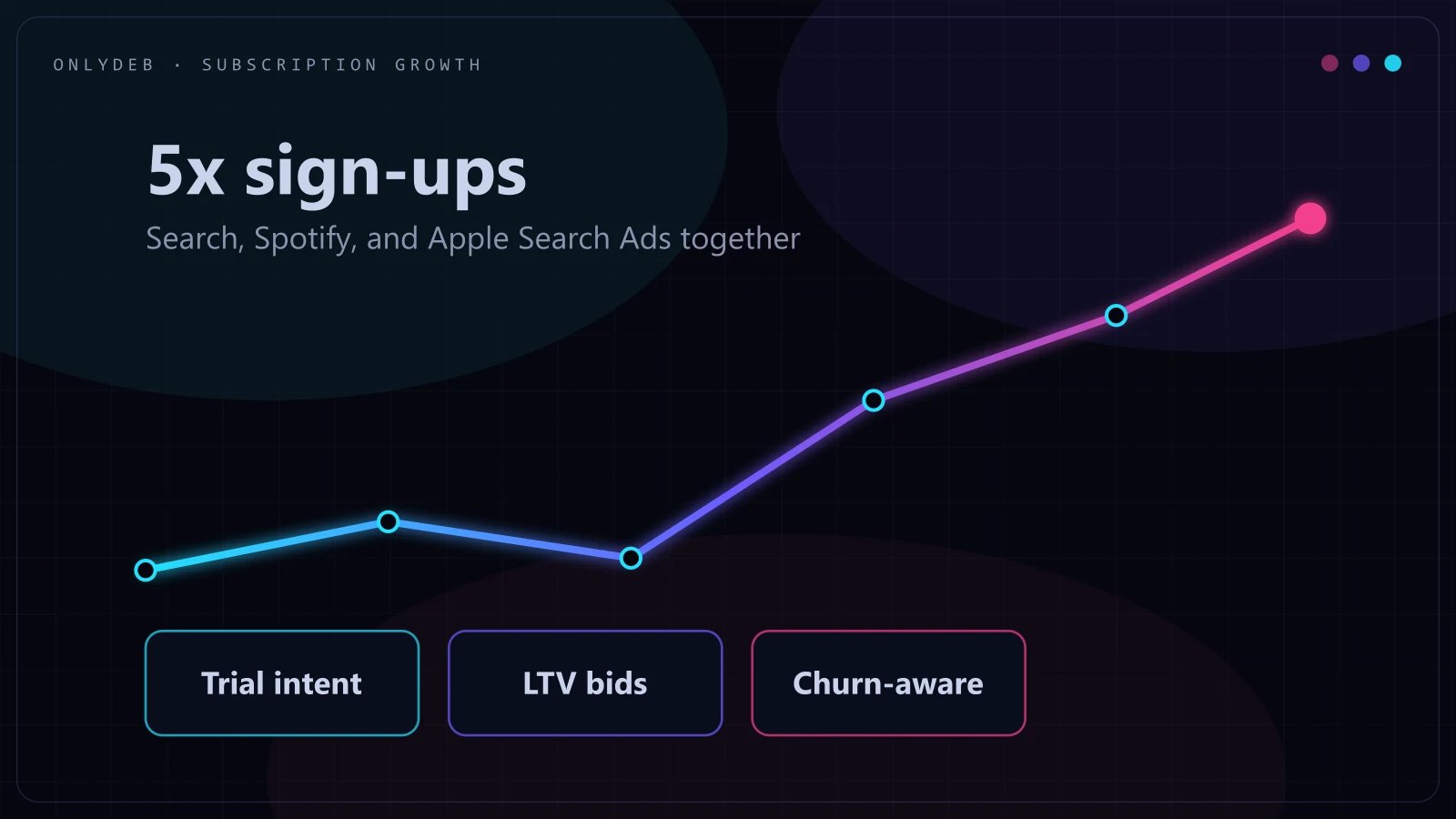
Three months into running paid acquisition for Bloomstories, a subscription audio platform, I remember staring at a Google Ads dashboard that said our campaigns were profitable and knowing it was lying to me. First-payment ROAS looked fine. New sign-ups were up. Nobody on the team was panicking. But I'd already seen enough subscription accounts to know that a healthy-looking chart at day one tells you almost nothing about whether the business is actually gaining ground, because the real cost of a subscriber and the real value of a subscriber both arrive on a delay. We were spending across Google Ads, Spotify Ads, and Apple Search Ads at over $100K/month combined, and if I optimized purely on what the dashboard showed me that week, I'd have scaled the wrong campaigns and quietly starved the ones actually building the business.
Google Ads for subscription businesses is the practice of bidding and measuring against lifetime value instead of the first transaction, since a subscriber's true worth only becomes clear after weeks or months of retention. Get the conversion event and the bidding target wrong here and the algorithm will scale you straight into a worse customer base, fast, and it will look like growth the entire time it's happening.
Why First-Payment ROAS Misleads Subscription Accounts
Ecommerce ROAS is honest in a way subscription ROAS isn't. When someone buys a $60 pair of shoes, the value of that conversion is $60, full stop. When someone signs up for a $12/month subscription, the value of that conversion on day one is whatever they paid for the first period, which tells you almost nothing about whether they'll still be paying in month four. A campaign that brings in subscribers who churn after one billing cycle can post a great first-payment ROAS and still be destroying the business, because the acquisition cost was paid once and the revenue never showed up again.
The fix isn't complicated in concept, it's just inconvenient in practice: value has to be modeled on projected lifetime revenue, or on a proxy for it, not on the first invoice. Early in the Bloomstories account, we shifted from judging campaigns on week-one ROAS to judging them on a blended view that weighted early retention behavior into the value passed back to Google Ads. That single change reordered which campaigns looked good. Some of our cheapest, highest-volume campaigns dropped in priority once we accounted for how quickly those subscribers churned. Others that looked mediocre on first-payment ROAS turned out to be sourcing the subscribers who stuck around.
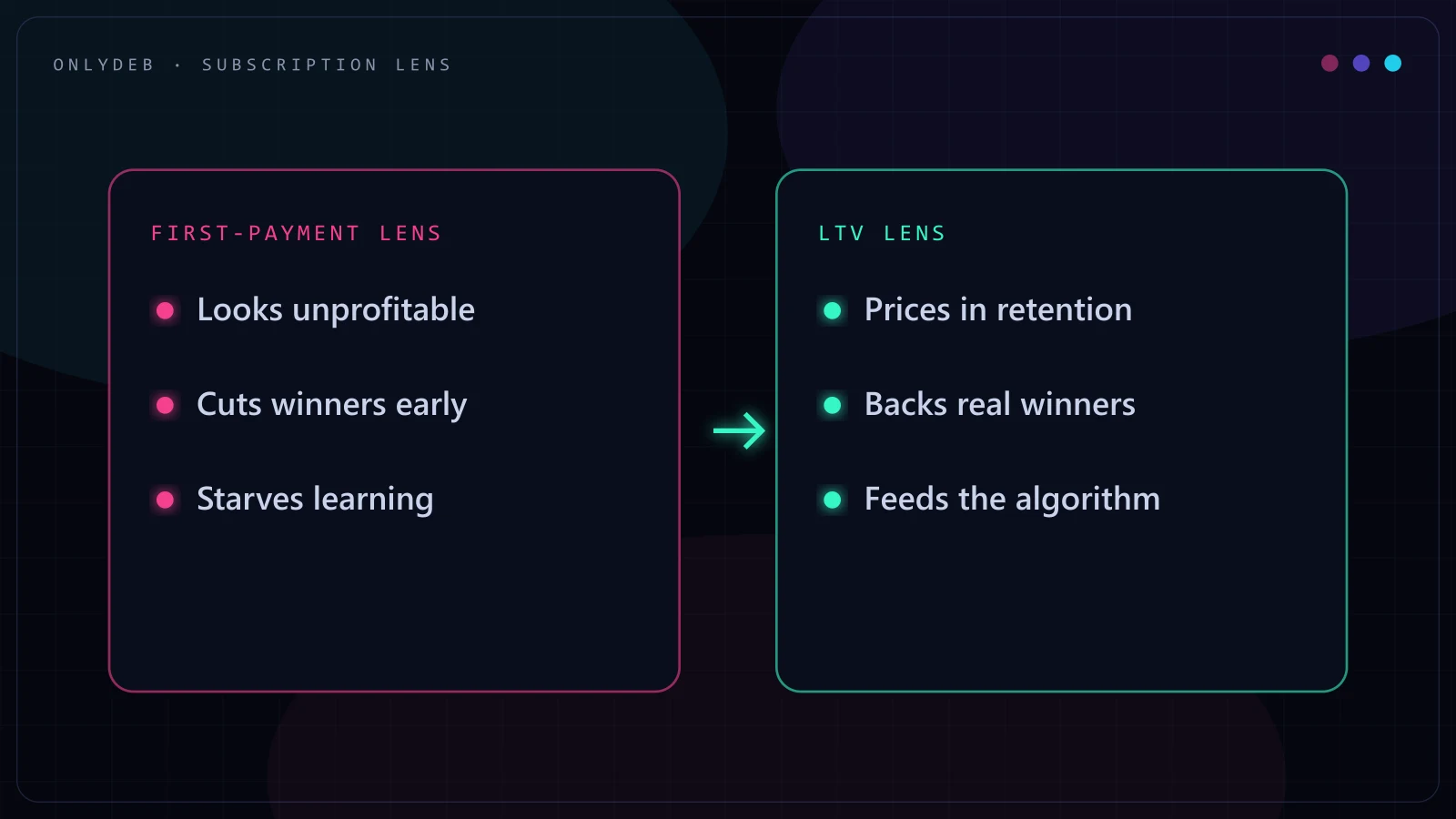
None of that shows up if you're still looking at a dashboard that treats a subscription conversion like a one-time purchase. If you want the fuller picture of which metrics actually predict durable growth versus vanity movement, I go through the broader framework in my guide to performance marketing KPIs.
Trial Intent vs Demo Intent vs Competitor Intent Keywords
Search intent in subscription categories splits into buckets that behave very differently once they hit the account, and lumping them into one campaign structure is one of the more common mistakes I see.
| Intent type | What the searcher wants | How it should be handled |
|---|---|---|
| Trial intent | Ready to try the product now, searching brand or near-brand terms plus "free trial" | Highest priority, tightest match types, fastest bidding response to volume changes |
| Demo intent | Evaluating whether the product fits before committing time to a trial | Separate campaign, softer landing page, expect a longer path to signup |
| Competitor intent | Actively comparing you against a named alternative | Its own budget line, its own creative, measured against a different cost ceiling |
Trial intent keywords convert fast and cheap, which is exactly why they get overweighted in account structures that don't separate them out, since they make the whole account look efficient while masking whether the business is actually reaching new demand. Demo intent keywords take longer to pay off and look worse on short attribution windows, but they're often the only source of net-new subscribers rather than people who were going to find you anyway. Competitor intent keywords deserve their own ceiling because a click that costs more but wins a subscriber away from a named competitor carries a different kind of value than the same subscriber found through a generic search.
Separating these into distinct campaigns, each with its own bidding target and its own patience threshold, is a large part of why the account could scale without collapsing into "spend more on whatever's cheapest this week."
Stop guessing with your ad spend.
I build highly profitable Google Ads acquisition systems for ambitious brands. Stop burning cash on broad match and let's scale your ROAS properly.
Choosing the Conversion Event: Signup vs Activation vs Paid Conversion
This is the decision that shapes everything downstream, and I've watched accounts get it wrong in both directions.
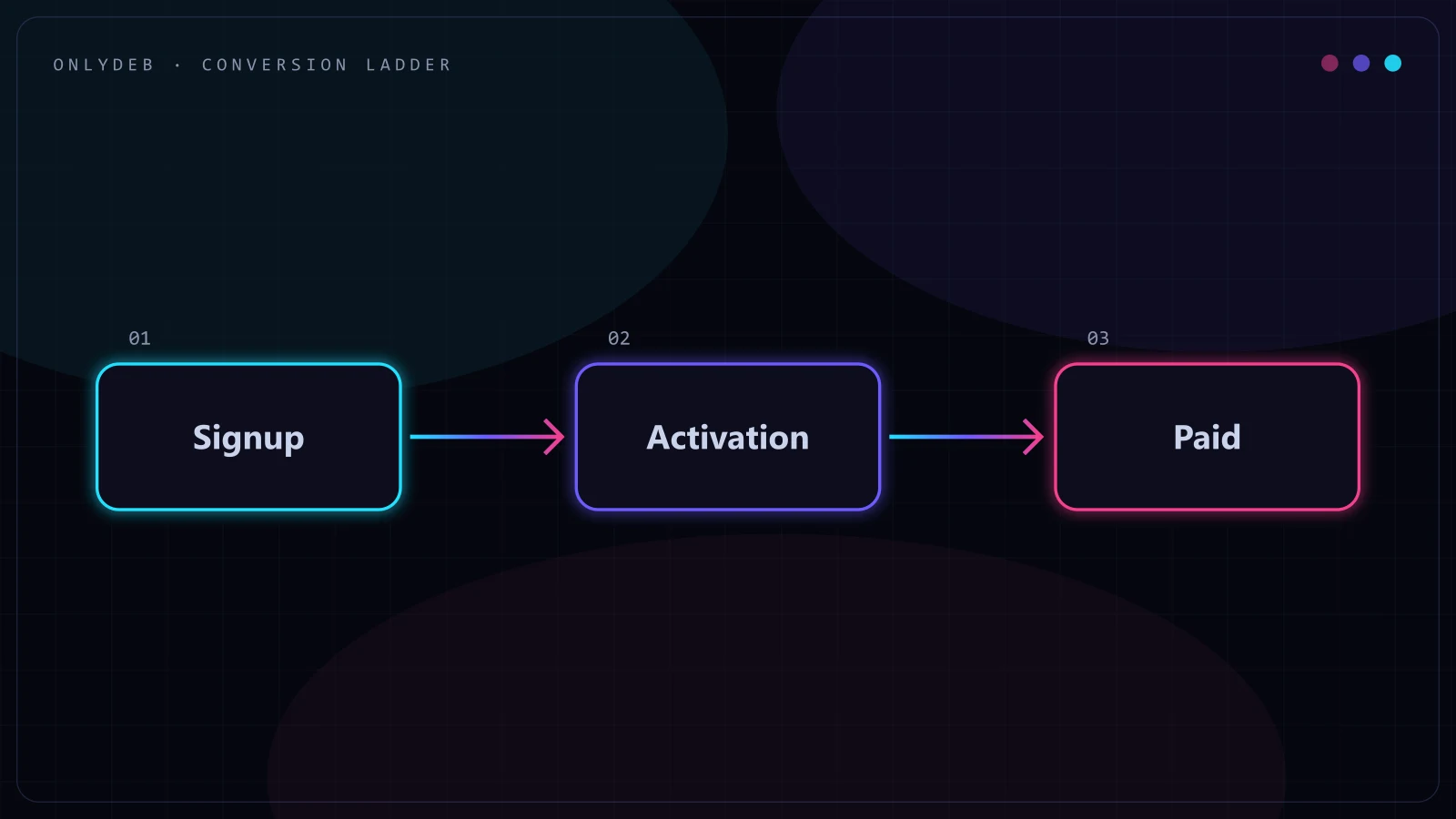
Optimizing on raw signup is the most common mistake. Signup is cheap, fast, and easy to game with an aggressive landing page, and Google's automated bidding will happily go find more people who sign up and never open the app again. Optimizing purely on paid conversion, the moment someone's first real payment clears, solves the quality problem but often starves the algorithm of enough volume to learn a pattern, especially on a trial-based product where paid conversion happens weeks after the click that started it.
Activation, the point where a new user actually does the thing the product exists for, tends to be the workable middle. For Bloomstories that meant completing a first listening session, not just creating an account. It's close enough to the click to arrive with usable volume and speed, and correlated enough with actual product engagement that optimizing toward it steers the algorithm toward people who stick around rather than people who bounce off a signup form. Getting this one choice right did more for account performance than any bid adjustment I made afterward.
Churn-Aware Optimization: Feeding Quality Signals Back
Google's bidding algorithms are only as good as what you tell them a conversion is worth, and most subscription accounts never tell them anything beyond the first payment. Churn-aware optimization means feeding a value signal back that reflects how a subscriber actually behaved, not just that they signed up.
In practice this doesn't require perfect real-time churn data, which almost nobody has cleanly available at the moment a conversion fires. It means using the retention data you do have, cohort by cohort, campaign by campaign, to periodically adjust the value assigned to conversions coming from each source. A campaign whose subscribers consistently churn within 30 days should get a lower value signal over time, even if its cost per signup looks attractive. A campaign whose subscribers stick around should get credit for that, even if its raw signup cost looks worse in isolation.
The cheapest sign-up and the most valuable subscriber are rarely coming from the same campaign, and only one of those numbers shows up on day one.
This is the same discipline behind reducing acquisition cost more broadly, treating cost per conversion as meaningless without a quality lens attached to it. I've written a fuller playbook on that approach in reducing customer acquisition cost, which applies just as directly to subscription accounts as it does anywhere else.
Running Google Alongside Spotify Ads and Apple Search Ads
Bloomstories ran budget across three channels at once, and the mistake to avoid is treating all three as competing for the same job. They don't. Each one tends to show up at a different point in how someone finds and decides on a subscription audio product.
Google Ads captured explicit search intent, people typing in a problem or a brand name, which made it the channel best suited to trial intent and competitor intent keywords where someone already knows roughly what they want. Spotify Ads reached people mid-listen, in a mindset closer to discovery than decision, which made it a better fit for building awareness of the product category rather than closing a signup in the same session. Apple Search Ads captured a narrower moment: someone already inside the App Store, already searching, already one tap from installing. That's about as close to bottom-of-funnel as paid acquisition gets for an app, and it competed for budget against Google Ads far more than it competed for the same user at the same moment.
Running all three well meant assigning each one a job instead of asking a shared dashboard to declare a single winner. Google Ads got measured on cost per activation from search intent. Apple Search Ads got measured on cost per install from App Store search intent. Spotify Ads got measured on assisted conversions and category awareness, since a last-click attribution model would have made it look worthless despite doing real work upstream. Comparing those three against one flat CPA number would have meant defunding the channel actually building the top of the funnel.
Brand Safety and Keyword Discipline for Sensitive Verticals
Bloomstories sat in NSFW-adjacent audio content, which meant keyword discipline wasn't optional, it was the difference between an account that stayed live and one that got flagged or suspended. Broad match keywords in this vertical can pull in search queries that put ads next to content or intent the brand has no business being associated with, and platform policy enforcement in sensitive categories tends to be less forgiving of an accidental match than in a typical retail account.
The keyword lists needed regular auditing, not a one-time setup, because search term reports in this category drift in ways that a standard ecommerce account never sees. Negative keyword lists had to be maintained more aggressively than usual, exact and phrase match got favored over broad match far more than I'd default to elsewhere, and ad copy went through review specifically for how it read out of context, not just how it performed. This is the kind of groundwork that never shows up in a performance report but determines whether the account is still running next quarter.
We also ran continuous A/B testing on creative and on the landing page itself, since a sensitive category can't rely on generic best practices built for mainstream products. What converted trial intent for a general productivity app didn't automatically translate, and testing had to account for both performance and brand safety at the same time, not sequentially.
Where This Leaves Subscription and SaaS Accounts
None of this is exotic. It's the same discipline that applies to any SaaS or subscription business running paid acquisition: know what a conversion is actually worth before you tell an algorithm to chase more of it, separate intent instead of averaging it together, and treat cross-channel budget as a set of different jobs rather than one shared scoreboard. The account that gets this right doesn't necessarily spend less. It spends toward subscribers who are still there in month six, which is the number that was never going to show up on a first-payment ROAS report anyway.
FAQ: Google Ads for SaaS and Subscription
What conversion should a SaaS or subscription business optimize on in Google Ads?
Optimize on the event that most reliably predicts a paying, retained customer, which for most subscription businesses is activation rather than raw signup or first payment. Signup alone is too cheap and too easy to game, and waiting for a paid conversion often starves the algorithm of enough volume to learn from. Activation, the point where a new user actually experiences the product, tends to sit at the right distance between the two.
Is Google Ads worth it for a low-price subscription product?
It can be, but the math has to work on lifetime value, not on the first charge. A $9/month subscription looks unaffordable to acquire if you judge it against a single payment, and perfectly reasonable if the average subscriber sticks around for eight or ten months. Before spending seriously, you need a real retention curve, not a guess, because Google Ads will happily scale spend against a conversion event that doesn't predict long-term revenue.
How do you measure LTV payback period for a subscription account?
Track cohorts by acquisition month and channel, then measure how many months of subscription revenue it takes for a cohort to cover its acquisition cost, including ad spend and any onboarding cost. A payback period under three months is generally healthy for a subscription business reinvesting into growth. Anything much longer means you're financing growth out of cash reserves, which is fine briefly but not a stable long-term structure.
Do Apple Search Ads compete with Google Ads for subscription apps?
They compete for budget more than they compete for the same user. Apple Search Ads captures people already inside the App Store actively searching for an app like yours, which is a narrower and more bottom-funnel audience than Google Search or Google Ads on the open web. The two channels tend to serve different stages of intent, so the right question is how much budget each deserves given its cost per install and downstream retention, not which one to drop.
What is a reasonable minimum budget to run Google Ads for a SaaS or subscription product?
Enough monthly spend to generate a meaningful number of the conversion event you're optimizing on, usually at least 30-50 conversions a month so the bidding algorithm has something to learn from. Below that volume, automated bidding strategies struggle to find a pattern and performance stays noisy regardless of how well the account is structured. The exact dollar figure depends entirely on your cost per conversion, which is why a structured audit before committing budget matters more than a generic number.
If your subscription or SaaS account is optimizing on the wrong conversion event, or you're running multiple channels without a clear read on what each one actually contributes, get in touch and let's look at your account together.