Google Ads for Baby Brands: What Running $300K a Month Taught Me
I inherited a $300K/month baby-products account and learned fast that this buyer isn't like other ecommerce shoppers. She's up at 3am, she's anxious, and she doesn't forgive a broken trust signal. Here's what kept CPA under $8 globally.

The account came to me mid-scale, already spending well past $300,000 a month across fetal dopplers and a broader catalog of baby gear, running Search and Shopping campaigns in global markets. That's not a small account to walk into cold. The real pressure comes from who's on the other end of every click.
Google Ads for baby brands is fundamentally a trust problem wearing an ecommerce costume. The mechanics look like any other product-based account: Shopping feeds, Search campaigns, bidding, seasonality. But the buyer is different in a way that changes almost every decision downstream of it, and missing that difference is how otherwise competent accounts underperform in this vertical.
A Different Kind of Buyer
Most ecommerce shoppers are comparing price and shipping speed. The baby products buyer is doing that too, but underneath it she's usually working through a much bigger question: is this safe for my kid, and can I trust the company selling it to me. A fetal doppler carries far more emotional weight than a typical impulse purchase. People buy it because they want reassurance about a pregnancy, often at 2am or 3am when anxiety is loudest and a doctor's office isn't open to answer the question that's keeping them up.
Pregnancy and early parenthood compress a lot of decision-making into a short window, and most of that decision-making happens alone, on a phone, late at night. There's no salesperson in the room to answer a follow-up question, so the ad and the page around it have to do that job on their own. A generic product ad built for a category where the stakes are lower, say, kitchen gadgets or phone accessories, simply doesn't carry the same weight here, because the buyer isn't just evaluating the product. She's evaluating whether the company behind it understands what she's actually worried about.
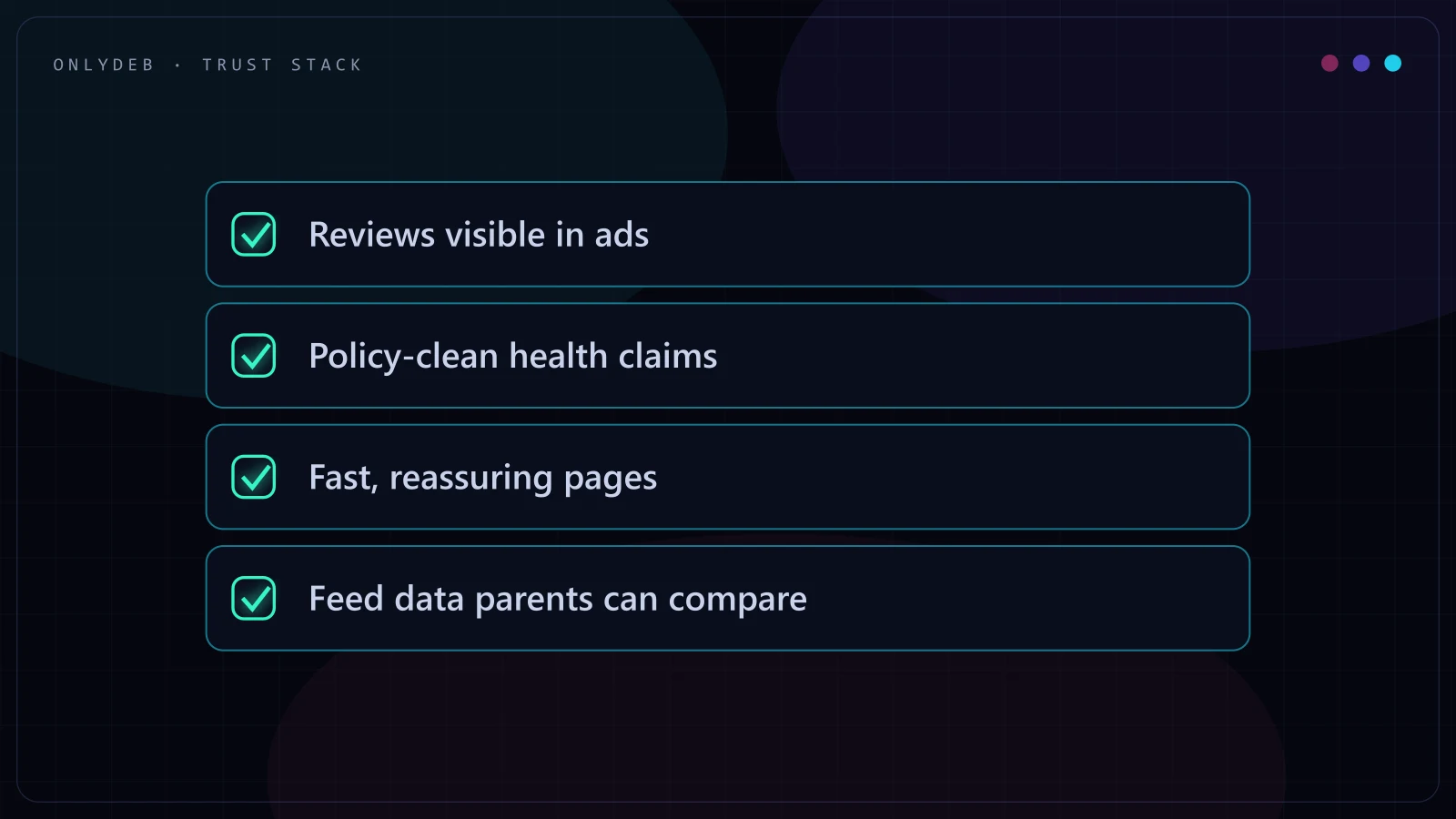
That changes what an ad needs to do. It's not enough to show the product and the price. The ad and the landing page both need to answer the unspoken question before the buyer even finishes reading: is this legitimate, has this worked for other parents, will this actually tell me what I need to know. Review counts, real testimonials, clear return policies, and visible trust badges aren't decoration in this account, they're conversion infrastructure. Strip them out and CPA climbs even if the product and price stay identical, because the ad stopped answering the question the buyer actually came with.
Feed Hygiene Carries the Weight
With a catalog this size running Shopping campaigns, the account lives or dies on the Merchant Center feed. Titles, GTINs, availability status, image quality, and category mapping directly determine which searches your products even get a chance to show against, far beyond typical back-office housekeeping. A miscategorized product or a stale availability flag quietly throttles impression volume across the whole account, and it rarely shows up as an obvious error when it happens.
Google's own Shopping ads policies spell out what breaks a feed's eligibility, and in a catalog this size the discipline is going through those requirements line by line rather than assuming a feed that worked at launch still works at scale. Feed hygiene is unglamorous work. It's also the single most important lever in a Shopping-heavy account, because bidding and copy can only optimize against traffic the feed lets through in the first place.
Stop guessing with your ad spend.
I build highly profitable Google Ads acquisition systems for ambitious brands. Stop burning cash on broad match and let's scale your ROAS properly.
Search and Shopping Play Different Roles
Shopping campaigns carried most of the volume on this account, which makes sense for a product-heavy catalog where showing the image and price directly in results shortens the path from search to purchase. But Search campaigns did a different job: catching the research phase. Parents-to-be search comparison terms, brand names they've heard from a friend, and specific questions before they're ready to buy anything. That's where ad copy, not product imagery, has to carry the trust signal, because there's no product photo to lean on yet.
Running both in parallel meant the account could meet the buyer wherever she was in the decision, whether she already knew what she wanted or was still working out whether the category made sense for her at all.
Seasonality That Actually Moves the Needle
This vertical runs on cliffs rather than gentle seasonality. Baby fairs, registry season, and holiday gifting windows pushed this account's revenue past $2M in a single seasonal peak, well above the roughly $300K/month baseline. That kind of swing punishes an account that reacts to demand instead of anticipating it. Shopping campaigns in particular need lead time, since a feed and a bid strategy need performance history built up well before a peak hits.
Budgets, bid caps, and inventory-aware messaging all needed adjusting ahead of those windows, not during them. Waiting until a spike shows up in the numbers means the account is already behind competitors who planned for it.
The buyer isn't comparing products. She's deciding whether to trust you at 3am, and the ad has to answer that before it answers anything else.
Why Policy Compliance Matters More Here
Health-adjacent products draw more scrutiny than a typical ecommerce SKU, and a fetal doppler sits close enough to that line that ad copy and landing pages need real discipline around claims. Google's healthcare and medicines policy covers what language crosses from descriptive into a medical claim, and getting that wrong risks more than a single disapproval, since Google can slow review velocity across the whole account while it re-evaluates the advertiser. Staying inside the lines keeps the account's overall trust with the platform intact so campaigns keep serving without interruption.
Review velocity matters in a second way too, on the customer side. In a trust-driven vertical, visible review counts and recency are part of what convinces an anxious buyer to convert. An account that treats reviews as a nice-to-have is leaving conversion rate on the table that a competitor with an active review pipeline is picking up instead.
What Carried Over From That Account
Managing that account for a little over a year, from January 2022 to February 2023, shaped how I think about trust-driven ecommerce broadly, not just baby products. Any category where the buyer is anxious, comparing options carefully, or shopping at odd hours because of a life event benefits from the same discipline: feed hygiene as a first-class task, trust signals treated as conversion infrastructure rather than branding, and seasonality planned for in advance instead of chased. I've written more generally about applying that kind of structure across product catalogs in my guide to Google Ads for ecommerce, and if your conversion tracking isn't solid enough to trust the CPA numbers you're seeing, that's worth fixing first, which I cover in my conversion tracking guide.
If you're running a product catalog in a category where trust matters more than price, the playbook from this account is a reasonable starting point, not a template to copy blindly. Every catalog and every buyer is different, but the underlying discipline, clean feeds, honest ad copy, and planning ahead of seasonal demand, transfers well beyond baby products. I go deeper on the broader ecommerce side of this in my work with ecommerce brands.
FAQ
Is baby gear a restricted category on Google Ads?
Most baby products themselves are not restricted, but the category sits close to health and safety policy areas that Google enforces strictly, especially anything making a medical claim (like a fetal doppler implying diagnostic use) or targeting pregnancy-related searches with sensitive personalization. Ad copy and landing pages need to stay factual and avoid language that reads as a health or medical guarantee.
What CPA is realistic for baby product ads?
It depends heavily on price point and margin, but the vertical is more forgiving on CPA than it looks because buyer intent is high and repeat purchase behavior exists across a baby's first year. On the account I managed at $300K+/month, we held CPA under $8 globally, though that number reflects a mature account with strong feed hygiene and a large volume of Shopping impressions, not a starting point for a new store.
Should baby brands run Shopping or Search campaigns?
Both, and they play different roles. Shopping campaigns carry the volume for a product-heavy catalog because they show the item, price, and image directly in results, which matters when buyers are comparing gear side by side. Search campaigns catch the research phase, questions, comparisons, and brand-name lookups, where trust signals in the ad copy do more work than the product image can.
How seasonal is the baby products vertical?
Very. Baby fairs, registry season, and holiday gifting periods can push a brand well past its usual monthly revenue, and I've seen seasonal peaks clear $2M in a single window on an account otherwise running $300K/month. Budgets and bid strategies need to flex ahead of those windows rather than reacting once the spike is already underway, since Shopping campaigns in particular need lead time to build performance history before a peak.
What is the minimum budget to run Google Ads for a baby brand?
Enough to sustain a Shopping feed with real impression volume and cover a Search campaign for higher-intent, higher-consideration terms. There is no universal number since it depends on product price and how competitive your specific category is, but a catalog too small or a budget too thin to generate meaningful feed data will struggle regardless of how well the account is built.
If you're running a baby brand, or any category where trust decides the sale before price does, get in touch and let's talk about what your account needs.