Anatomy of a $2M Season: Running Google Ads Through Peak
Four phases, one account, and a season that either compounds a year of work or wastes it in three weeks. Here's the campaign diary from a Google Ads account that held a sub-$8 CPA through $2M+ in seasonal revenue, and the discipline that made the panic-scaling instinct lose every time it showed up.

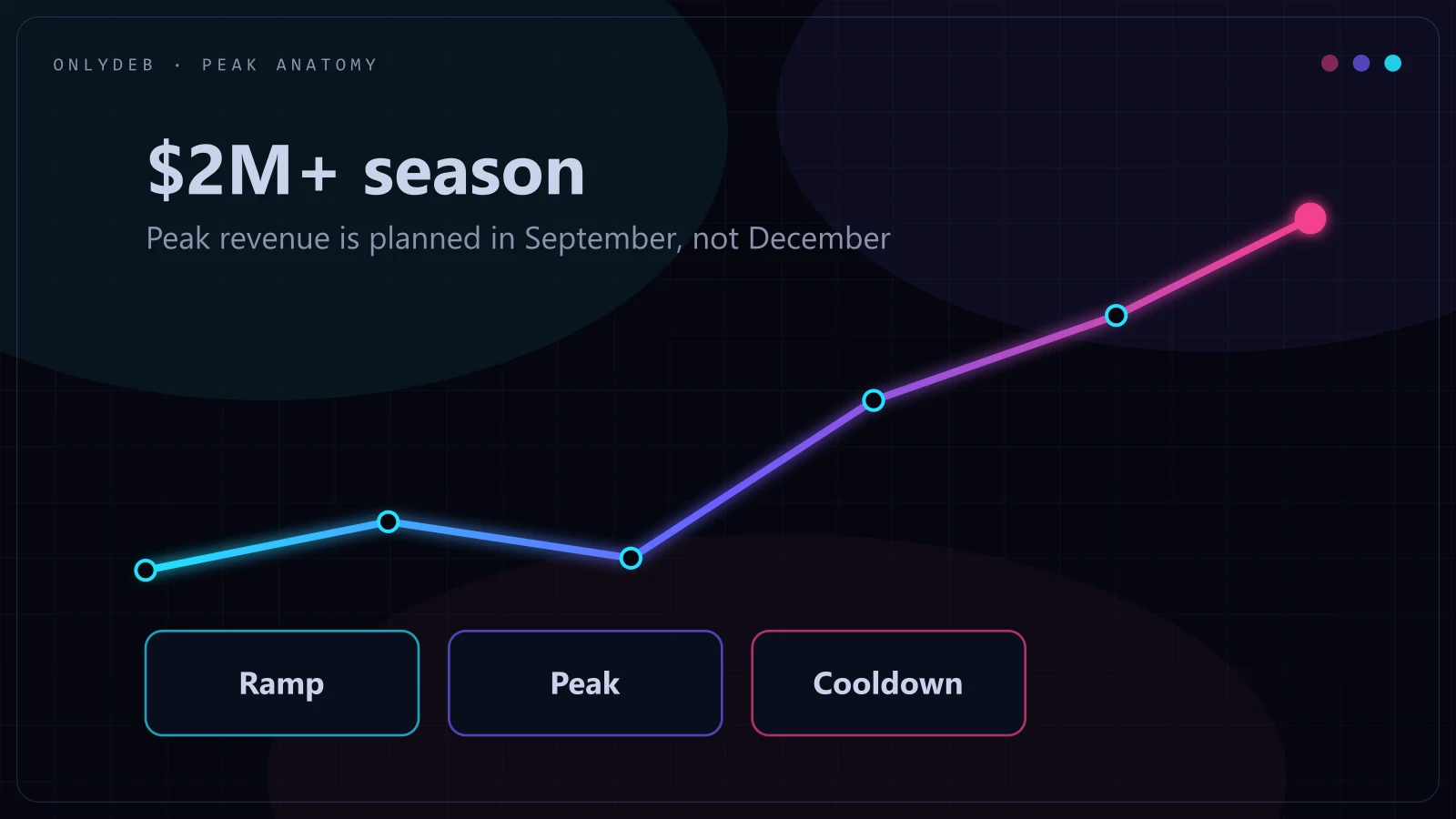
The week before peak, the account is quiet in a way that feels almost suspicious. Spend is steady, the dashboards are calm, and every instinct says there's still time to fix one more thing. That's the week that decides the whole season, because by the time the first real spike hits, every lever you didn't already pull is a lever you no longer get to pull without breaking something. I've run a Google Ads account through that exact stretch, watched it climb past $300K a month, hold a sub-$8 CPA through $2M+ in seasonal revenue at a 400% ROAS, and I've watched the same account nearly get talked into throwing that away in a single panicked afternoon. This is the diary of how that season actually went, phase by phase.
Most people think peak season is something that happens to an account. It isn't. It's something an account either survived because of decisions made weeks earlier, or got wrecked by because of decisions made in the moment. The difference between those two outcomes rarely shows up as one big call. It shows up as dozens of small ones, most of them about what not to touch.
Peak season on Google Ads is the compressed stretch of weeks, sometimes days, when demand spikes hard enough that ordinary account habits stop working, and the outcome is decided far more by what was set up months in advance than by anything you do once the spike is underway. By the time you're inside it, the account is running on the targets, budgets, and bid strategy discipline you brought into it. Peak season doesn't reward reaction. It rewards preparation you can no longer see once the traffic arrives.
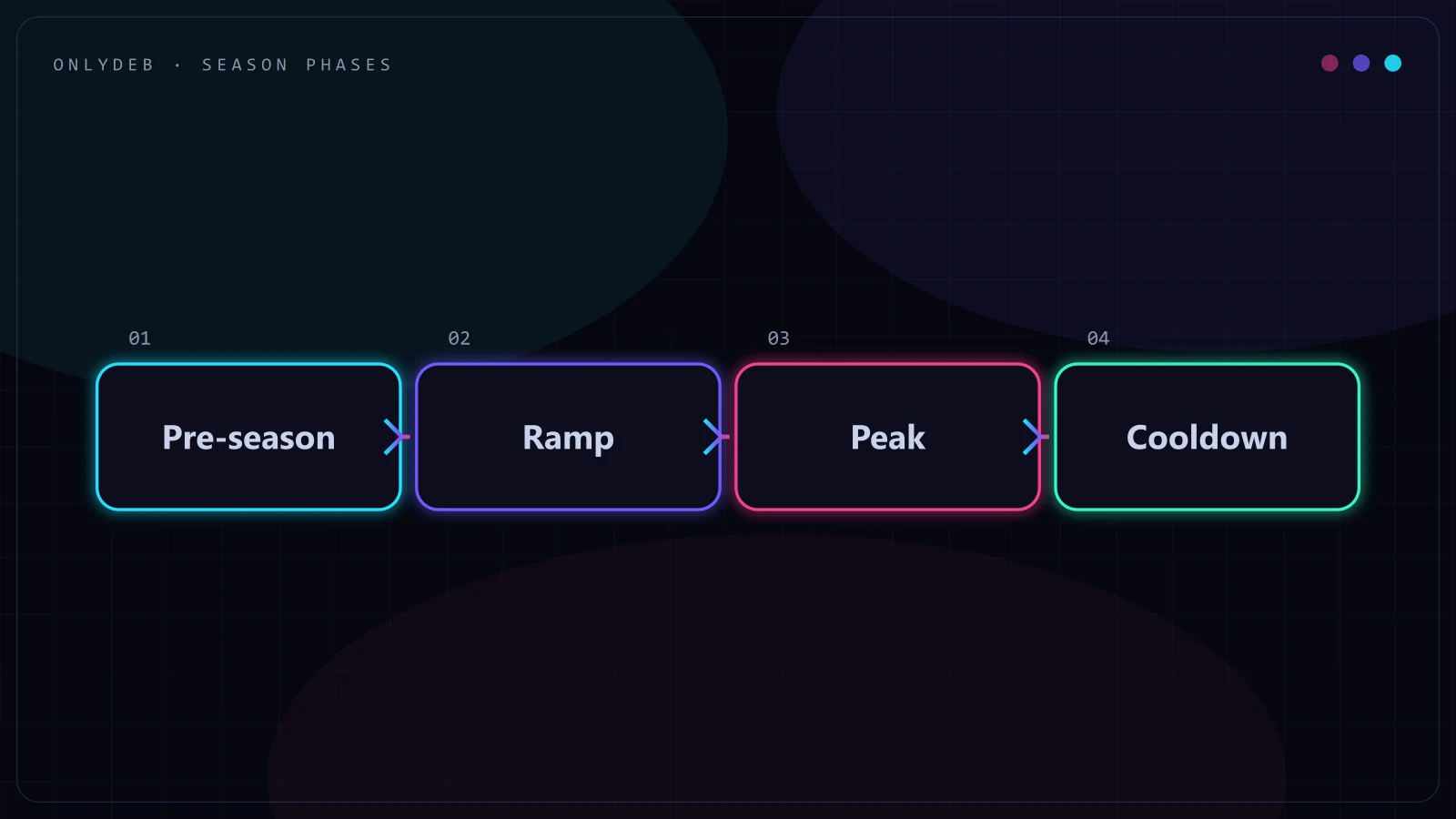
Pre-Season: The Work Nobody Sees
On the account that became a $2M+ season, the real work started in September, months before a single peak-week dollar was spent. September is quiet. Traffic is normal, the team isn't stressed, and it's exactly the window where the account can absorb changes without any risk of them colliding with a demand spike. That quiet is the asset. Waste it and you're making the same structural decisions in December under pressure instead of in September with room to think.
Three things happened in that window, in this order. First, targets got set from margin, not from a round number pulled out of last year's results. A tROAS target that doesn't reflect what each product or service actually earns after cost is a target that either throttles your most profitable lines or overspends on the ones that were never going to be worth it, and peak season is the worst possible time to discover that gap. Second, budgets for the entire season got approved in advance, as real numbers with a client or stakeholder sign-off, not a vague "we'll increase as needed" that turns into a frantic approval request during the second-busiest week of the year. Third, the feed and account structure got cleaned while nobody was watching: disapproved products fixed, stale audiences trimmed, conversion tracking checked line by line. I go through what that cleanup actually looks like in my breakdown of running ecommerce accounts at scale, and the short version is that almost none of it is glamorous. It's the boring maintenance that peak season punishes you for skipping.
None of this is unique to ecommerce, either. Anyone building a seasonal budget without a documented plan for what gets approved, when, and against what target is setting up the exact scramble I'm describing. I laid out the planning mechanics in more detail in my guide to Google Ads budget planning, and peak season is the highest-stakes version of that same discipline.
Stop guessing with your ad spend.
I build highly profitable Google Ads acquisition systems for ambitious brands. Stop burning cash on broad match and let's scale your ROAS properly.
Ramp: Raising Budget Without Resetting the Machine
Ramp is where most accounts make their first real mistake, and it's an understandable one. Demand starts climbing, the temptation is to match it dollar for dollar right away, and a budget that doubles overnight feels like the responsible move. It isn't. Google's automated bid strategies learn delivery patterns over time, and a sudden, large jump in budget throws the strategy back into a learning phase at the exact moment you need it operating with confidence. I've watched an account do this to itself: budget doubled in a day, and the following week looked worse than the week before the increase, not because demand fell, but because the algorithm was busy relearning instead of spending with any precision.
The version that works is slower and less satisfying to announce in a status update. Budget goes up in increments of roughly 20-30% every few days, timed against actual demand signals rather than a calendar guess. Through the ramp, I watch lost impression share on the search side closely, since that number tells you whether the account is actually being capped by budget or by something else (a bid ceiling, an approval issue, a quality problem) that raising spend won't fix. Raising budget to chase a metric that isn't budget-constrained just burns money faster without solving the actual limiter.
Google publishes its own guidance on handling predictable demand spikes without breaking Smart Bidding's learning, in its documentation on seasonality adjustments, and the logic lines up with what I've seen hold up in practice: telegraph the spike to the system in a controlled way rather than letting a sudden real-world jump surprise it.
Peak: What You Touch and What You Refuse to Touch
Then peak arrives, and the account that spends $300K+ in a normal month is suddenly doing multiples of that across a handful of weeks, on its way to $2M+ for the season. This is the part nobody prepares people for: the busiest weeks of the year are, deliberately, the weeks where you touch the account the least. Targets are set. Budget is approved. The bid strategy has the room it needs to spend. The job during peak isn't to optimize harder. It's to hold the line while everyone around you, understandably, wants you to react to every noisy signal the dashboard produces.
A single soft day inside a strong week is not a trend, and reacting to it as one is how a good week gets talked into a worse one. I watch performance in 3-5 day windows during peak, never a single day in isolation, because daily volatility in a high-spend, high-demand environment is normal, and tightening a target or pausing a campaign off one bad Tuesday almost always costs more than the Tuesday itself did.
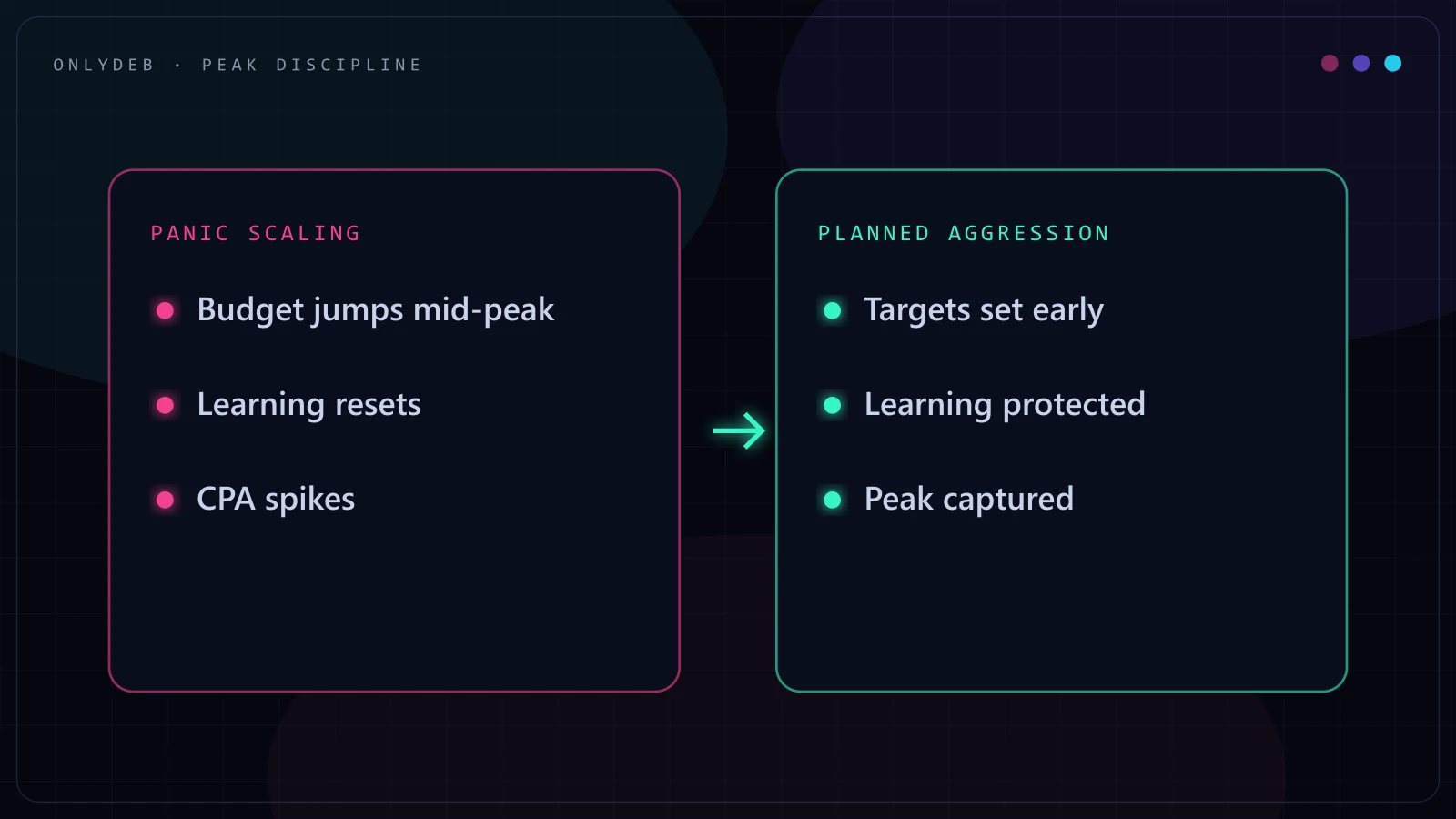
The temptation that shows up every single peak season is panic scaling: a big day happens, and the instinct is to shove another 50% into budget immediately to "catch the wave," or a slow morning happens and someone wants to slash the target to force cheaper conversions before lunch. Both moves come from the same place, mistaking a short-term signal for a structural one, and both moves reset stability the algorithm needs most in that exact week. Planned aggression looks almost boring by comparison: budget was already sized for this week back in September, the target was already set from real margin, and the only job left is to not flinch.
The account that wins peak season isn't the one that reacts fastest. It's the one that had already decided, weeks earlier, what it would refuse to react to.
Cooldown: Harvesting the Season Without Poisoning January
The season doesn't end when the last peak-week order comes in. It ends once the account has been reset, and that reset is where a lot of otherwise well-run peak seasons quietly go wrong. Two things need to happen in the cooldown, and both get skipped more often than they should.
First, harvest what the season actually taught the account: which campaigns, audiences, or product lines carried disproportionate weight, what search terms surfaced during the spike that weren't there in normal months, where the bid strategy struggled even with a stable target. That information is genuinely valuable and gets thrown away constantly, because everyone's exhausted by the time peak ends and moves straight to the next thing.
Second, and this is the part I've seen do real damage when skipped: targets and expectations have to reset back toward normal-demand levels, deliberately, not by drifting there on their own. A CPA or ROAS number generated during a demand spike reflects that spike, not the account's baseline performance. Carry a peak-week CPA into January as the new benchmark, and every normal-month result looks like underperformance against a number the account was never going to hit outside of peak. I've watched good accounts get restructured, and good managers get second-guessed, purely because nobody reset the comparison point before judging the next month against it.
That reset discipline matters whether the account runs on Shopping, standard Search, or a lead gen setup with a completely different demand curve. The shape of the spike changes. The need to plan for it in advance, ramp into it gradually, hold steady through it, and deliberately step back down out of it afterward, doesn't.
FAQ
When should I start planning for peak season?
Months before the first order of the season comes in. On the account I ran to $2M+ in seasonal revenue, the planning work started in September for a peak that landed in the final quarter of the year. Targets, budget approvals, and feed cleanup happened while traffic was still quiet, because none of that work is possible once the account is already under load.
How fast should I raise budgets heading into peak season?
In small steps, not one jump. I raise budgets in increments of roughly 20-30% every few days during the ramp, rather than doubling spend overnight. A sudden jump resets the bid strategy's learning phase right when you need it most stable, and a campaign relearning delivery mid-ramp will underperform a campaign that scaled gradually into the same peak.
Should bid strategy or targets change during peak itself?
As little as possible, and only in the direction of patience. The instinct under pressure is to tighten targets when a day looks soft or loosen them the moment a day spikes, and both reactions usually do more damage than the volatility they're reacting to. I set the bid strategy and targets before peak starts and hold them through the noisy days, watching trend lines over 3-5 days rather than judging any single day in isolation.
What should I do with the account right after peak season ends?
Cooldown is its own phase, not an afterthought. I pull the learnings while they're fresh (which SKUs, audiences, or campaigns carried the season), then reset targets back toward normal-demand levels rather than leaving peak-week settings running into a quieter month. A CPA that looked fine during a demand spike will look inflated in January, and judging the account against that number instead of resetting it is how good accounts get restructured for the wrong reasons.
Does this apply to lead gen accounts too, not just ecommerce?
Yes, though the shape of the spike differs. A lead gen account tied to an enrollment window, a tax deadline, or a seasonal service still sees a compressed period where demand jumps and lead quality can swing hard in either direction. The same four-phase discipline applies: set targets from what a lead is actually worth in advance, ramp budget gradually, hold the bid strategy steady under pressure, and reset expectations once the window closes.
If you've got a peak window coming and the plan for it currently lives in a few Slack messages and a hope, that's the gap that turns a good season into a scramble. Get in touch and let's build the actual plan before the traffic arrives.