Google Ads for Local Lead Generation: 100 to 500+ Daily Leads
I've run a local service account from 100 daily leads to 500+, and almost none of that growth came from raising bids. It came from fixing the geo targeting, the campaign structure, and the landing page, in that order.

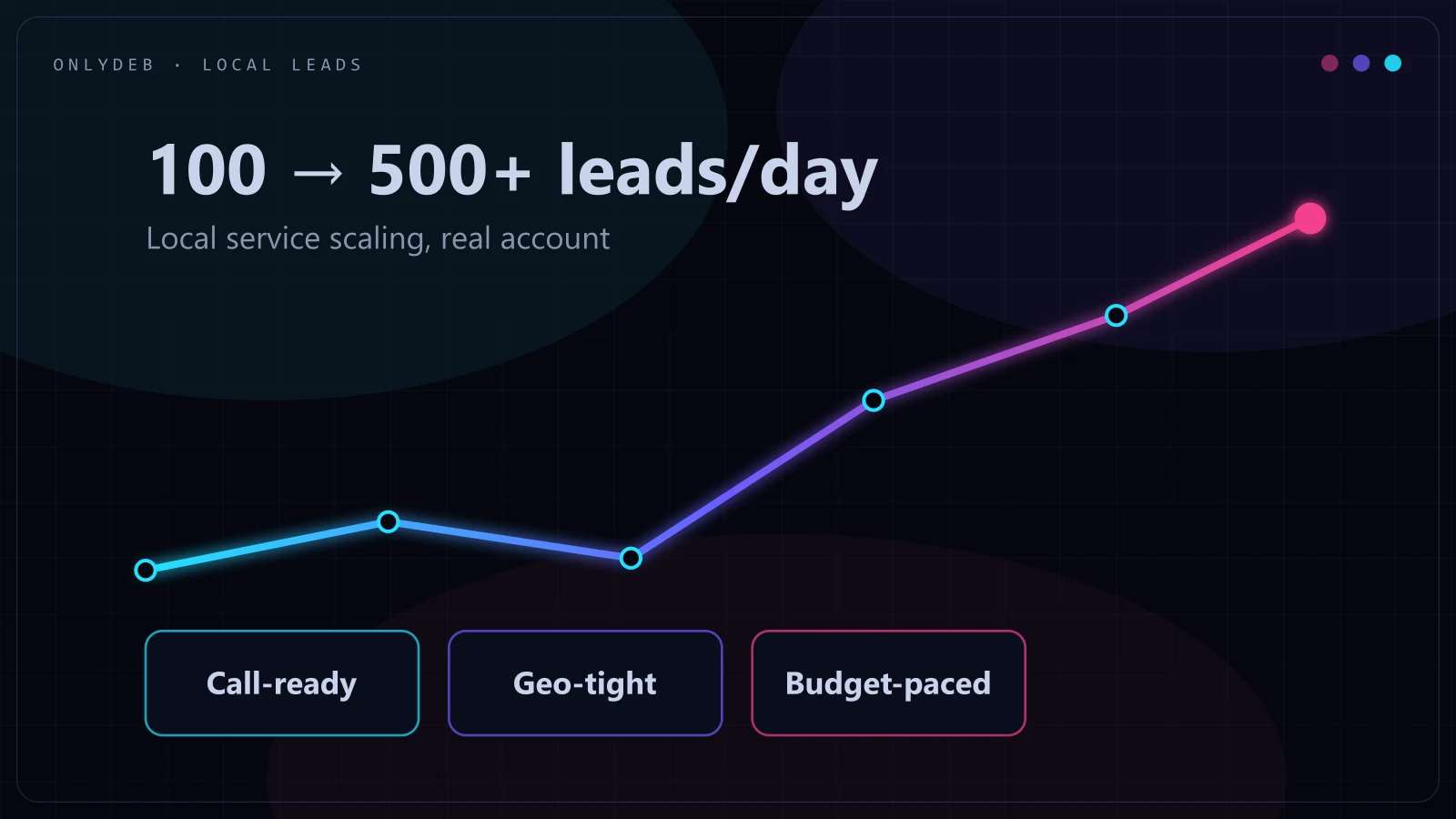
Most local service accounts I inherit make the same three mistakes before I ever touch a bid. They target one big radius around the business address instead of the neighborhoods people actually call from. They treat every click the same, whether it's someone with a broken garage door right now or someone three weeks out doing research. And they send every visitor to a homepage built for browsing, not a page built to get a phone to ring in the next ten minutes.
None of that is a Google Ads problem, exactly. It's a structure problem. The account can hit every Quality Score benchmark and still underperform because it wasn't built around how a local customer actually behaves. Fix the structure and the account starts converting the traffic it was already paying for.
Local lead generation with Google Ads is the practice of matching campaign structure, geo targeting, and landing pages to how nearby customers actually search and call, rather than running a generic search campaign over a wide radius. It leans on call tracking, tight service-area targeting, and dayparting instead of broad reach, because the goal is qualified calls from people who can actually be served, not impressions across a whole metro area.
Geo Targeting That Matches Real Service Areas
The single biggest lever I pull on a local account, before touching keywords or ad copy, is geo targeting. Most accounts default to a radius around the business location, and radius targeting is almost always wrong for a service business. It includes areas the crew can't reach in a reasonable drive time and excludes pockets of demand just outside the circle.
What I do instead is build targeting around the actual service area, zip code by zip code or city by city, based on where jobs get completed and where technicians are dispatched from. Some zones get their own campaigns with their own budgets, because a dense, high-call-volume area deserves more daily spend than a fringe area that only produces a handful of jobs a week. Bid adjustments follow the same logic: raise them where the close rate is proven, pull them back where the drive time eats the margin.
Call-Focused Campaign Structure
Local service businesses live or die on the phone, so the campaign structure needs to be built around calls from the start, not bolted on afterward. That means call extensions and call-only assets are live from day one, forwarding numbers are set up before the first click lands, and conversion actions are split between calls and form fills instead of lumped into one generic "lead" event.
Structurally, I separate campaigns by service type and, where volume supports it, by urgency. A broken spring or a door that won't open is an emergency call. A quote request for a new door install is a slower, more considered purchase. Mixing those into one ad group means your ad copy, your bids, and your landing page all end up compromised for both intents instead of sharp for either one.
Local Services Ads earns a spot alongside Search for the same reason. It's built for pay-per-lead phone calls and carries a trust badge that matters for home services, but it can't do everything a well-built Search campaign can, so I run both rather than picking one.
Stop guessing with your ad spend.
I build highly profitable Google Ads acquisition systems for ambitious brands. Stop burning cash on broad match and let's scale your ROAS properly.
Search Terms Discipline: Emergency vs. Research Queries
Search term review is where most local accounts leak budget quietly. Someone searching "garage door repair near me" tonight and someone searching "how much does a garage door cost" this weekend are both valid, but they are not the same buyer, and they should not share a bid strategy.
I tag search terms into two buckets on a rolling basis: emergency intent (repair, broken, stuck, won't open, same day) and research intent (cost, price, install, best, reviews). Emergency terms get higher bids and call-first ad copy. Research terms get a slower nurture path, often toward a landing page with pricing context and reviews rather than a hard call-now push. Negative keyword lists get built from this same review, cutting anything that's clearly a DIY search, a job search, or a competitor brand term that snuck in through broad match.
This is the same discipline I've written about for cutting wasted spend generally. If you haven't read the playbook on reducing customer acquisition cost, the search term audit process there applies directly to local accounts too.
Landing Pages That Answer the Phone
A local service ad can be flawless and still lose the lead on the landing page. The page has one job for an emergency searcher: get them to call in the next few seconds, not read a paragraph about company history.
- Click-to-call above the fold: A visible, tappable phone number at the very top, not buried after a hero section.
- Proof that's fast to scan: Reviews, years in business, and service-area coverage stated in a line or two, not a full testimonial carousel someone has to scroll through.
- Speed over polish: A page that loads instantly on a phone matters more here than a page that looks impressive on a desktop monitor.
I've covered the mechanics of this in more depth in the landing page optimization guide, but for local lead gen specifically, the test is simple: could someone standing in their driveway with a broken door get you on the phone in under ten seconds from this page? If not, the page is the bottleneck, not the campaign.
Budget Pacing Across the Day
Local intent isn't flat across a 24-hour period, and neither should the budget be. Morning searches skew toward same-day scheduling. Midday and early evening often carry more research intent from people planning ahead. Late night calls, when they happen, are almost always genuine emergencies willing to pay for fast service.
Rather than letting the daily budget run out by early afternoon (a common failure mode I see when I open a new account), I set bid adjustments by hour so spend holds through the hours that actually produce calls for that specific business. A garage door account and a plumbing account will have different curves. The fix is watching the account's own call data by hour, not importing someone else's schedule.
What Actually Changed Between 100 and 500 Leads
Scaling a local lead-gen account from 100 daily leads to 500+, which is what happened on the Garage Doors LA account, didn't come from one big change. It came from a sequence, and the order mattered.
First, the geo targeting got rebuilt from a single radius into zone-based campaigns, so budget could be pushed toward the areas already converting instead of spread evenly across areas that weren't. Second, the campaign structure split by urgency and service type, which let emergency call volume scale on its own budget without getting starved by research-intent spend. Third, search term review tightened enough that wasted clicks stopped eating headroom, which freed real budget to reinvest in the zones and hours already proven to convert. Only after those three were solid did raising overall budget actually turn into more leads instead of more expensive clicks. Scaling spend before fixing structure is how accounts end up with a bigger bill and the same lead count.
FAQ
How much budget does local lead generation need on Google Ads?
It depends on your service radius and call volume goals, not a fixed rule. Start small enough to fund full daily coverage of your actual service area rather than spreading a thin budget across a wide radius. A tight, well-funded area that generates consistent calls beats a wide area that runs out of budget by noon.
Are Local Services Ads or Search Ads better for local lead generation?
They do different jobs. Local Services Ads are built for pay-per-lead phone calls and carry the Google Guaranteed badge, which helps trust for home services especially. Search campaigns let you control match types, ad copy, and landing pages directly. Most accounts I run use both, with Search handling the research and comparison queries LSA cannot reach.
How fast do results come with local lead generation campaigns?
Calls can start on day one because local intent is already high. The account still needs a few weeks of search term review, negative keyword cleanup, and landing page adjustments before lead volume stabilizes at a level you can plan a business around. Treat the first month as calibration, not a verdict.
How do you track phone call conversions in Google Ads?
Use Google forwarding numbers on the site so calls from ads get tracked as conversions automatically, paired with call length thresholds so a 6-second hang-up does not count the same as a 3-minute booking call. Layer in call recording review so you can tell a qualified lead from a wrong number, not just a connected call.
Does this local lead generation playbook work outside the US?
The structure holds anywhere Google Ads supports geo targeting and call tracking, including the UK, Canada, Germany, and the Netherlands. What changes market to market is the mix of emergency versus research search volume and how people expect to book (phone versus form), so the campaign structure needs a local read, not a copy-paste.
If your local service account is stuck at a lead volume that hasn't moved in months, the fix is usually structural, not a bigger budget. I've rebuilt geo targeting, campaign structure, and landing pages for accounts in exactly this spot. If you want a second pair of eyes on yours, get in touch through work with me and I'll tell you plainly where the leaks are. For a broader look at how this plays out across home services, HVAC, and other local categories, see my local services page.