Google Ads vs Meta Ads in 2026: Where Should Your First Dollar Go?
I manage both platforms, and I get asked to pick a side almost weekly. The honest answer hangs on one question about your customer, and once you answer it, the first-dollar decision mostly makes itself.

I have spent 8+ years running Google Ads and Meta Ads side by side, and the question I get asked more than any other is some version of "which one should I be on?" People want me to pick a side. Agencies pick sides all the time, usually the side they happen to sell. I can't do that honestly, because I have watched both platforms carry an account, and I have watched both platforms waste money, sometimes in the same quarter.
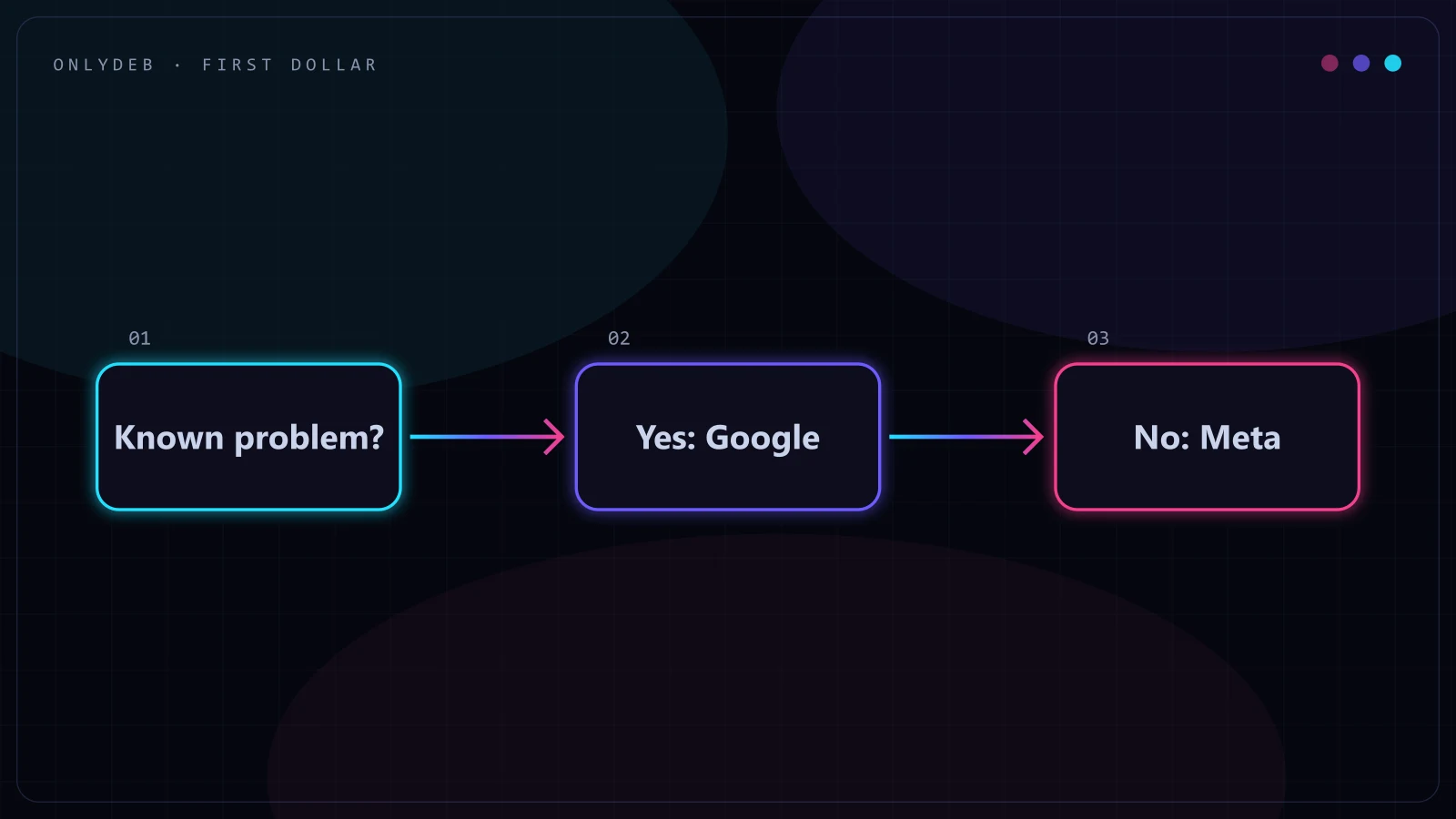
What I can do is tell you the one question that actually decides it: does your customer already know they have the problem? If they know, and they type it into a search bar, Google gets the first dollar. If they don't know yet, or they know but never search for it, Meta gets the first dollar because someone has to put the idea in front of them. Everything else in this comparison is detail hanging off that one question.
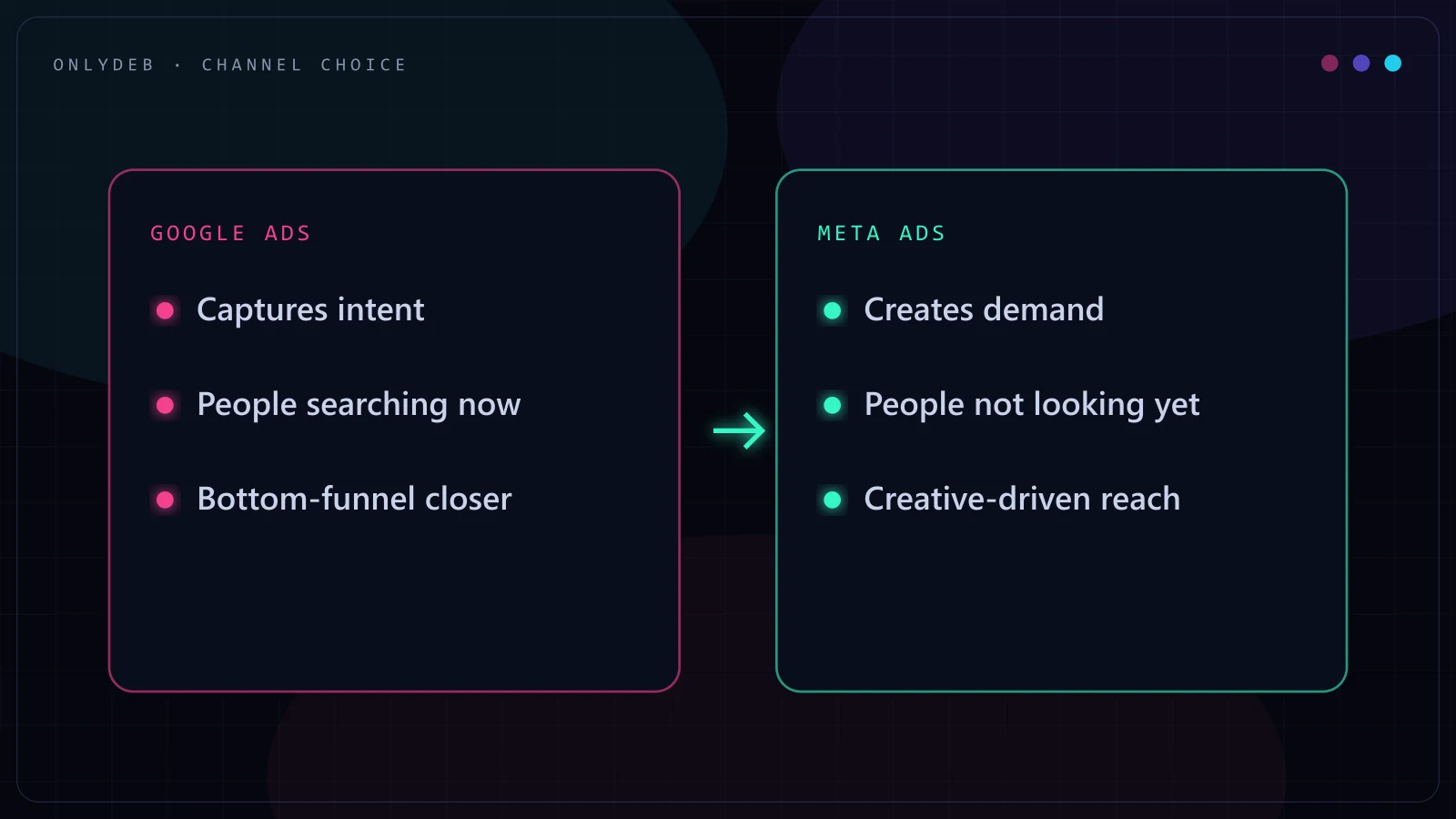
The difference between Google Ads and Meta Ads is the direction the demand flows. Google captures demand that already exists: someone searches, you intercept. Meta creates demand that didn't exist yet: someone scrolls, you interrupt with something worth stopping for.
Intent Capture vs Demand Creation: The Real Distinction
Most comparisons of these platforms read like spec sheets: audience sizes, ad formats, targeting options. None of that decides anything. The real distinction is what state of mind the person is in when your ad reaches them.
On Google, the person raised their hand first. They typed "emergency garage door repair" or "baby heartbeat monitor" into a search box, which means the problem, the awareness, and often the budget already exist. Your job is to show up, be relevant, and not fumble the landing page. I saw this at full strength with Dagamma, an ecommerce account I ran at $300K+/month in spend, driven by search and shopping. We held CPA under $8 at that scale because the demand was already there, day after day. We didn't create a single buyer. We caught them.
On Meta, nobody raised a hand. Your ad interrupts someone mid-scroll who was looking at a friend's holiday photos two seconds earlier. That sounds like a disadvantage until you notice what it buys you: reach into the enormous population of people who would want your product but will never search for it, because they don't know it exists or don't know their problem has a name. I lived on that side of the line at Bloomstories, an audio storytelling subscription where we grew sign-ups 5x across Google, Spotify, and Apple Search Ads. Almost nobody wakes up and searches for "immersive audio fiction subscription." The growth logic there was demand creation: put the product in front of the right audience, make them curious, and let the interest ripple outward. That is Meta-style thinking, and it applied across every channel we ran.
Google finds the people who are looking. Meta finds the people you are looking for.
Where Google Wins the First Dollar
If any of these describe your business, start on Google and don't overthink it.
- Emergency and local services. Nobody discovers a locksmith on Instagram while their key sits snapped in the lock. They search, they call whoever shows up first, and the transaction closes within the hour. I took Garage Doors LA from about 100 daily leads to 500+ almost entirely on search. Meta had no meaningful role to play there, because the moment of need arrives without warning and expires within hours.
- High-intent ecommerce. If people search for your product category by name, with model numbers and "buy" and "best price" attached, Search and Shopping are the shortest path from budget to revenue. Dagamma's sub-$8 CPA at $300K+/month existed because thousands of parents were already searching for exactly what the store sold.
- B2B with a searched pain. When your buyer types the pain into Google ("SOC 2 compliance software," "fleet fuel card"), a search click is the cheapest qualified conversation you will ever buy. The volumes are small, the CPCs sting, but each click is someone with the problem, mid-decision, often with sign-off authority.
The common thread: the demand pre-exists, it is expressed in words, and those words can be bought.
Where Meta Wins the First Dollar
Flip the conditions and the answer flips with them.
- New-category products. If your product solves a problem people haven't named, search volume is a graveyard. You can't capture demand that doesn't exist. Meta lets you show the product doing its job in a 15-second video, and the viewer goes from unaware to intrigued inside one thumb-stop. This was the Bloomstories problem in miniature: you cannot buy searches nobody makes, so you build the wanting first.
- Impulse-friendly ecommerce. Products under an impulse price point, with strong visual appeal and instant "I want that" energy, thrive in a feed. The purchase decision takes seconds, so an interruption is all the runway you need.
- Audience-definable niches. Some businesses have customers who are easy to describe but hard to catch searching. New parents, recent movers, engaged couples, fans of a specific hobby. If you can describe your buyer better than you can describe their search query, Meta's targeting and lookalike machinery is built for you.
Stop guessing with your ad spend.
I build highly profitable Google Ads acquisition systems for ambitious brands. Stop burning cash on broad match and let's scale your ROAS properly.
The Measurement Trap When Comparing Them
Here is where most "we tested both and Google/Meta won" stories fall apart. Each platform grades its own homework, and each one grades generously in its own favor.
Last-click attribution flatters Google. Search sits at the end of most buying journeys, so a model that hands full credit to the final click makes Google look like it produced customers it merely closed. Meanwhile, view-through conversions flatter Meta: someone scrolls past your ad without clicking, buys three days later for unrelated reasons, and Meta's dashboard takes a bow. Put those two dashboards side by side and your combined "conversions" can exceed your actual order count. I have opened accounts where the two platforms together claimed 140 sales in a month the store's backend recorded 90.
Comparing them honestly takes three moves. First, pick one neutral source of truth: your CRM, your backend revenue, or analytics with one consistent attribution model applied to both. Second, look at marginal cost per customer as you scale each platform, because averages hide the point where the next dollar stops working. Third, when the stakes justify it, run incrementality checks: geo holdouts, pause tests, anything that shows what happens to total revenue when a platform goes dark. I go much deeper on this in my guide to PPC attribution modeling, but the short version is: never let either platform referee its own match.
How They Compound When Run Together
The comparison framing hides the most useful fact about these platforms: they feed each other. Meta creates awareness; some of that awareness turns into searches; Google captures the searches. A person sees your Meta ad on Tuesday, doesn't click, then googles your brand on Saturday when the need becomes real. In the dashboards that looks like a cheap branded search conversion. In reality it is a relay: social created the demand, search caught it.
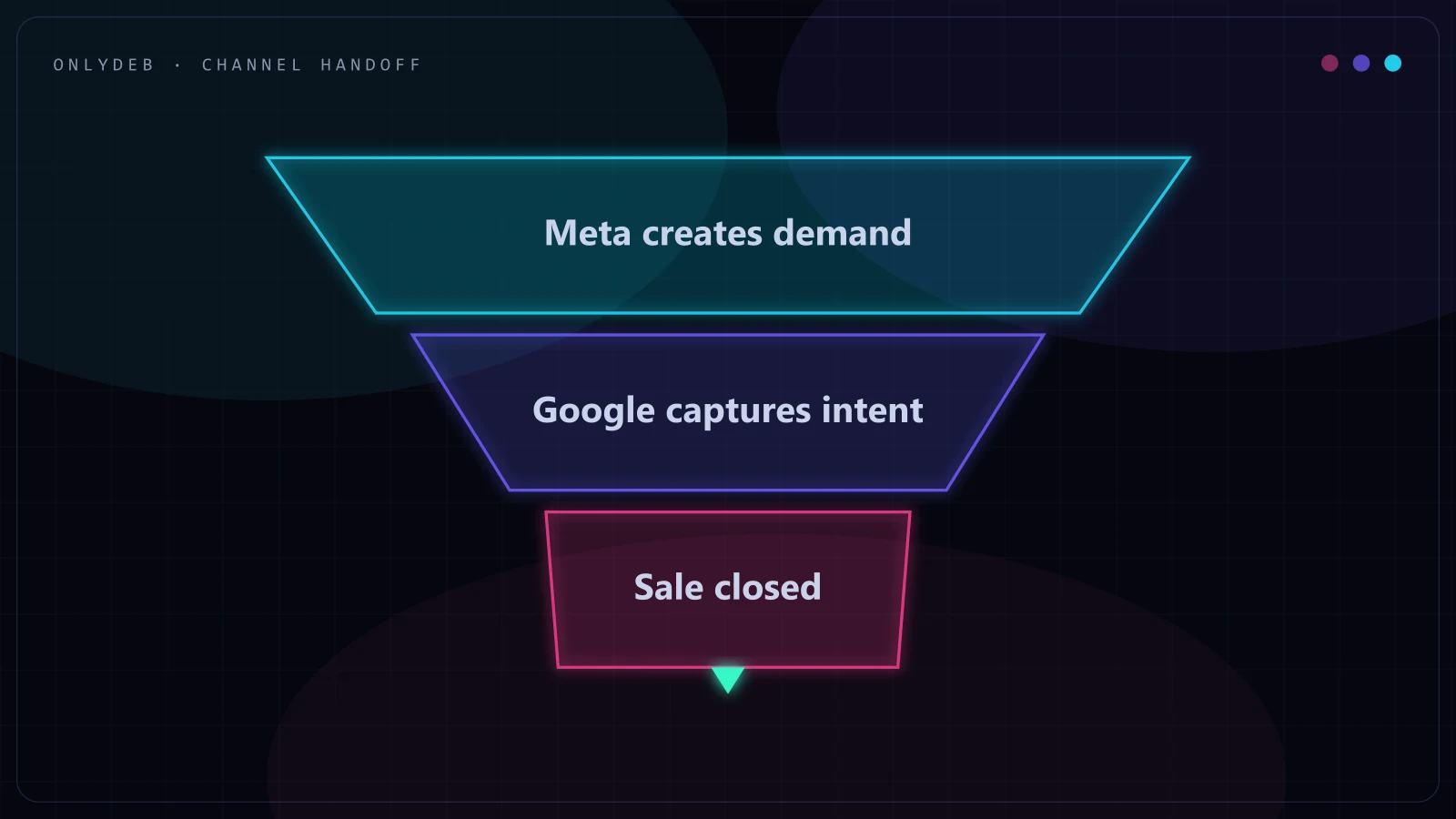
You can watch this happen in your own data. Turn on serious Meta prospecting and, within weeks, branded search impressions climb. Turn Meta off and branded search cools with a lag. Once both platforms are live, the useful question stops being "which is better" and becomes "which stage of the journey is underfunded right now." That question, and the operational mess of answering it across ad accounts, is the subject of my cross-platform PPC management playbook. Running both well accounts for a large share of the $5M+ in ad spend I have managed, and the accounts that scale furthest are almost always the ones where both engines run.
A Decision Framework by Business Type
Here is how I actually call it when a new client asks. First platform, then the signal that tells you it's time to add the second.
| Business type | First dollar | Signal to add the second platform |
|---|---|---|
| Ecommerce (searched category) | Google (Search + Shopping) | Search impression share is maxed and CPA rises when you push budget; Meta prospecting opens new demand |
| Ecommerce (new or visual product) | Meta | Branded search volume grows; add Google to capture the demand your creative built |
| SaaS / B2B | Google if the pain is searched; Meta or LinkedIn if the category is new | On Google: problem keywords are saturated. On social: sign-ups arrive but volume plateaus and search demand appears |
| Local service | Google (Search + Local Service Ads) | You dominate local search and want repeat, referral, or seasonal demand; Meta handles remarketing and offers |
| Lead gen (considered purchase) | Google for searched problems | Cost per lead climbs as you widen keywords; Meta lead forms extend reach to people earlier in the decision |
The pattern behind every row: start where your customer's awareness already is, and expand toward the platform that reaches the stage you can't currently buy. The signal to add the second platform is almost always the same signal, in two costumes: the first platform's efficient volume has a ceiling, and you have hit it.
FAQ
Is Google Ads or Meta Ads cheaper?
Neither is cheaper as a rule. Google clicks cost more per click because you are paying for declared intent, but a higher share of those clicks convert. Meta impressions and clicks cost less, but you are paying to interrupt people who were not looking, so more of the budget goes to building interest before anyone buys. The only cost comparison that matters is cost per qualified customer in your own account, measured over the same window on both platforms.
Which platform works faster?
Google usually shows revenue faster when search demand for your product already exists, because you are intercepting people mid-decision. Meta can take longer to produce buyers since it often reaches people earlier in their thinking, but when a creative connects with the right audience it can scale volume faster than a search term with limited monthly queries ever could.
Can a small budget run both at once?
Usually not well. Splitting a small budget across two platforms means neither one gets enough conversion data for its bidding system to learn, so both underperform. Pick the platform your business type points to, run it until it produces steady conversions, and add the second only when the first has stopped growing efficiently.
Which is better for B2B?
If your buyers actively search for the pain you solve, Google wins the first dollar, because a searched problem is the strongest buying signal in B2B. If your category is new and nobody searches for it yet, Meta or LinkedIn has to create the demand first. Check real search volume for your problem keywords before deciding; that answer settles it for most B2B companies.
How do I compare results between them fairly?
Never compare each platform's self-reported numbers, because each one measures in a way that favors itself. Last-click flatters Google, view-through flatters Meta. Judge both against a neutral source such as your CRM or backend revenue with one consistent attribution model, and run incrementality checks like geo holdouts to see what each platform actually adds.
If you are staring at this decision for your own business, I do this evaluation for a living, on both platforms, with my own hands on the accounts. Tell me about your business and I'll tell you where your first dollar should go, even if the answer turns out to be a platform I'm not pitching you.