Spotify Ads and Apple Search Ads: A Field Guide From $100K a Month of Real Spend
A Google-only playbook works right up until your product is something people listen to instead of search for. Here's what I learned running Spotify Ads and Apple Search Ads alongside Google Ads at $100K+/month, and why the three channels lie to you in different ways.

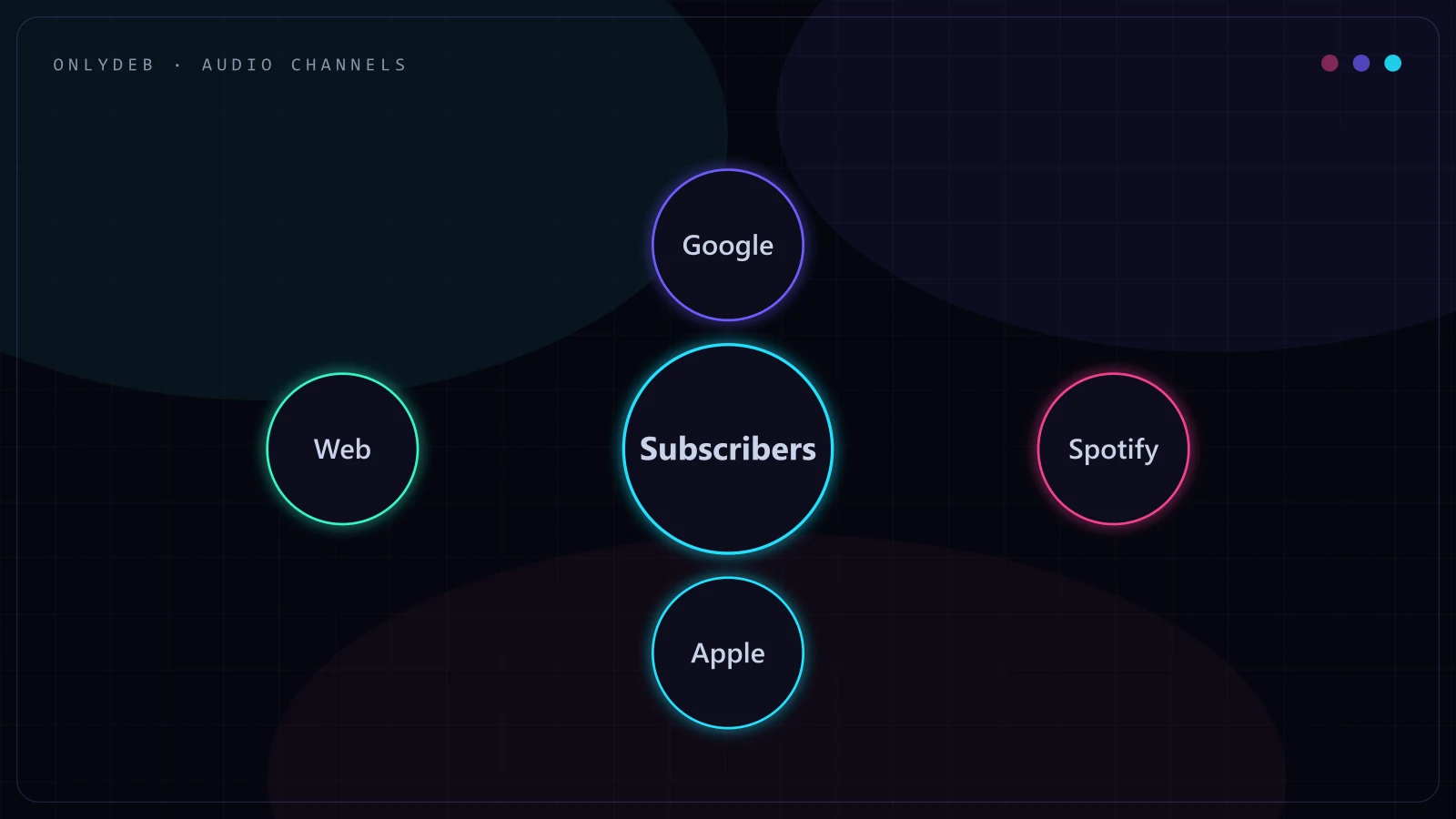
At Bloomstories, a subscription audio platform, there was a specific week the Google Ads account stopped being the whole strategy. Search volume for what we did was thin, because the people most likely to subscribe weren't typing anything into Google. They were browsing Spotify, half-listening to a playlist, or already inside the App Store deciding between us and a competitor. Google Ads caught the sliver who searched a branded or category term. It had nothing to say about everyone else, and everyone else was most of the addressable audience.
Spotify Ads and Apple Search Ads are two channels that solve a problem Google Ads can't: reaching people who haven't typed a query yet, either because they're listening rather than searching, or because their intent lives inside an app store instead of a search box. Once I added both alongside Google Ads, the account stopped being Google plus two extras and became a system where each channel fed the next traffic, awareness, or install intent it couldn't generate on its own.
What Spotify Ads Actually Buys You
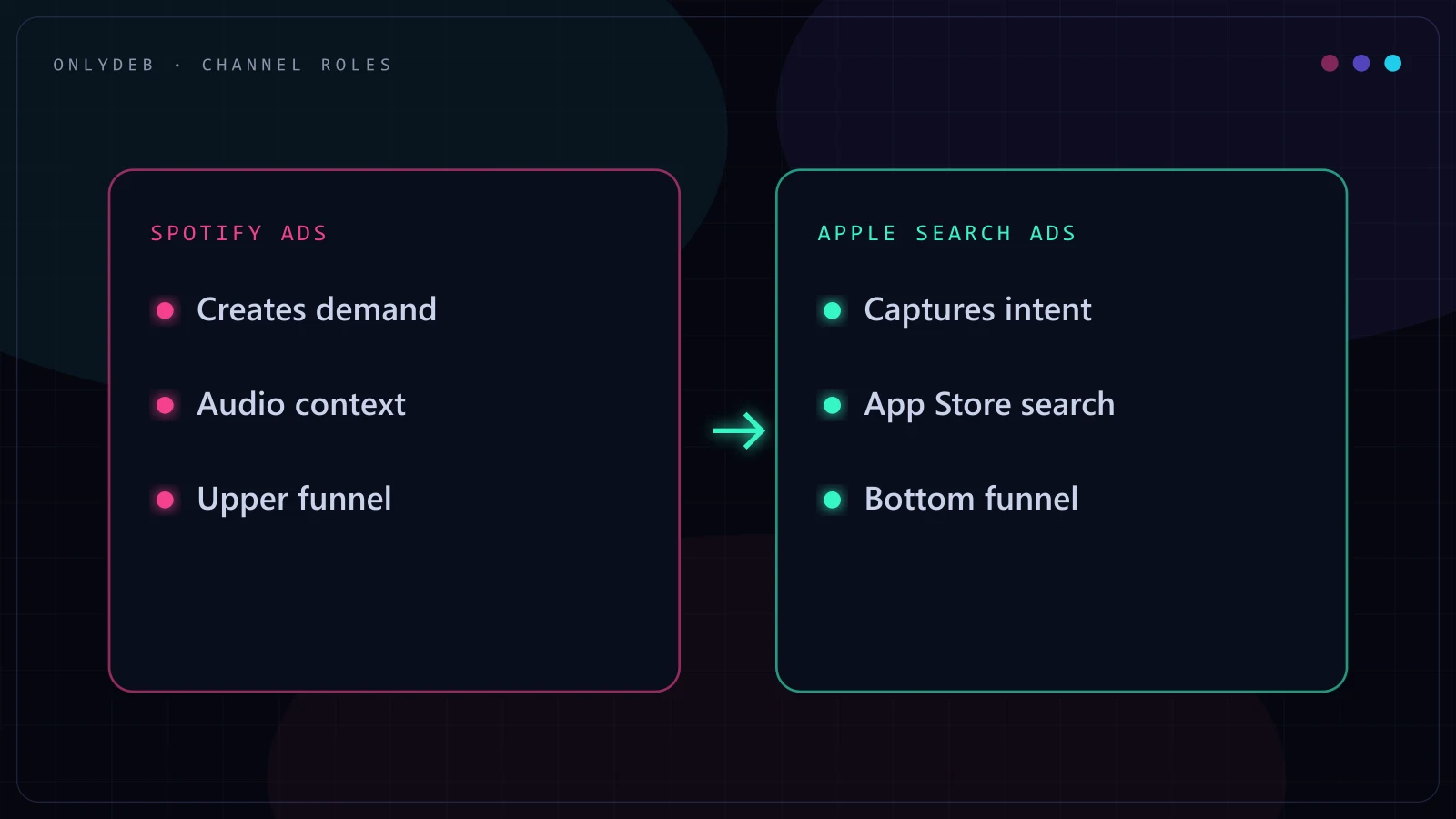
Spotify Ads Manager, the self-serve platform at ads.spotify.com, sells audio-context reach: your ad plays between songs or podcast segments to a listener already engaged with audio, not scrolling past a banner. Nobody is searching for a subscription audio app while they listen to one on Spotify. What you're buying is demand creation, putting the product in front of someone whose listening habits (long sessions, podcast consumption, specific genre or mood) correlate with being a good fit.
The targeting runs on listening behavior rather than search intent: genre, mood, playlist context, device, and podcast category. That's a strength if your audience has a real behavioral signature, and a weak spot if you force search-style keyword thinking onto a platform that doesn't work that way. The campaigns that performed at Bloomstories weren't the ones targeting the broadest audio audience. They targeted listening patterns that matched people already primed for long-form audio, since that's the habit our product needed them to already have.
Stop guessing with your ad spend.
I build highly profitable Google Ads acquisition systems for ambitious brands. Stop burning cash on broad match and let's scale your ROAS properly.
What Apple Search Ads Actually Buys You
Apple Search Ads is the opposite kind of channel, and it's worth reading Apple's own documentation at searchads.apple.com before assuming it works like a mobile version of Google Ads. It doesn't. ASA puts your app at or near the top of App Store search results for a term someone actually typed, so every impression is attached to a person at minimum considering downloading an app like yours right now. That's about as close to bottom-funnel intent as advertising gets outside of branded search.
For a subscription product, the terms worth bidding on split into two buckets: your own brand name (defensive, usually cheap, though competitors sometimes bid on it) and category or competitor terms where someone is actively comparing options. The install isn't the finish line, since a subscription business lives or dies on trial-to-paid conversion, not raw downloads. ASA gets someone into the funnel efficiently. What happens after the install is a product and onboarding question, not an ads question, but a bad answer there makes even a cheap ASA install look expensive in hindsight.
How Each Channel's Numbers Lie to You Differently
The hardest adjustment moving from a Google-only account to a three-channel one was accepting that "performance" means something different in each dashboard, and comparing them at face value produces bad decisions.
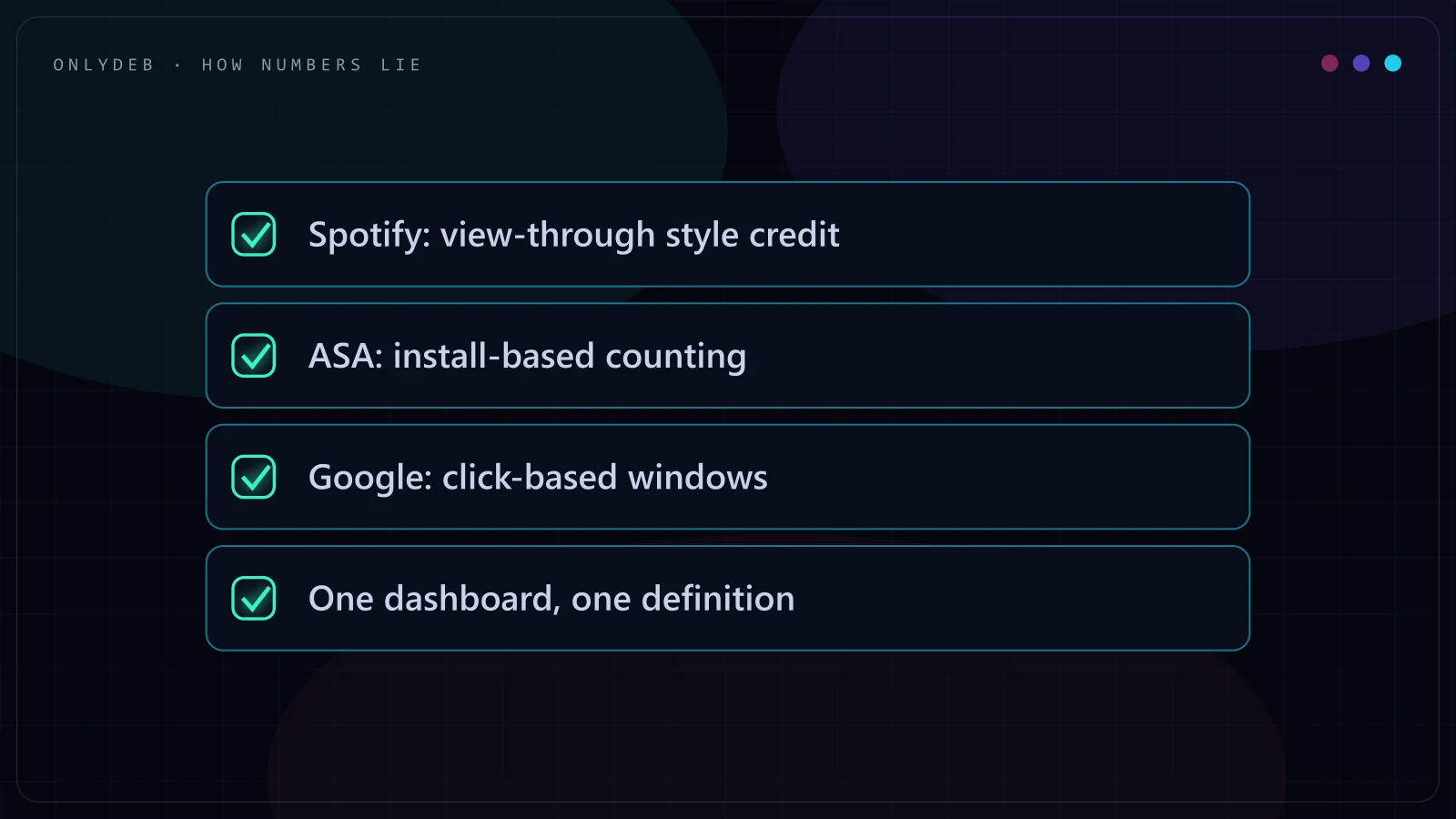
| Channel | What the dashboard reports | Where it misleads you |
|---|---|---|
| Google Ads | Clicks and conversions, mostly last-click or data-driven attribution | Undercounts assist value from Spotify-driven brand search and direct traffic |
| Spotify Ads | Reach, frequency, and completion rate; some view-through style reporting | Has almost no native concept of a conversion, so judging it on last-click makes it look worthless |
| Apple Search Ads | Impressions, taps, and installs | Reports installs, not trials or paid subscribers, so a cheap install can still be a bad customer |
Google Ads gives you the cleanest attribution because it's built around a click and a landing page you control. Spotify is closer to a reach and frequency platform, and the honest way to judge it is watching branded search volume and direct traffic move after a campaign flight, not expecting a conversion number that means what Google's does. Apple Search Ads sits in between: installs report cleanly, but an install isn't a subscriber, so ASA data has to connect back to your own trial-to-paid numbers to know whether the traffic was actually good.
The channel that looks worst on paper is sometimes the one making the other two look good.
Splitting Budget Across Three Channels
I won't hand you a percentage split, because the right one depends on category search volume, App Store competition, and how much of your audience is reachable through audio. What matters more is the order of operations: fund Google Ads first and fully, since it captures demand that already exists and leaving branded or high-intent search underfunded wastes the cheapest conversions available; fund Apple Search Ads next, since App Store intent is a strong signal on its own; and let Spotify's budget flex on top as the demand-creation layer, sized to how much of the other two channels' growth traces back to rising brand awareness. Treating the three as competing for one fixed pool, as if funding Spotify meant starving Google, was my early mistake. Spotify's real job was growing the pool: more branded search, more direct App Store visits, more people ready to convert when the other two caught them at the bottom of the funnel. Cut Spotify to fund more Google spend and the Google numbers shrink too, because you've cut off part of what was feeding them.
Audio Creative Constraints
Audio ads have one structural limitation that changes everything about how you write for them: there's no visual to lean on. A display or video ad can build to a reveal; an audio ad has maybe fifteen to thirty seconds, no image, and a listener doing something else while it plays. The scripts that worked stated who the product was for and what to do next within the first few seconds, because waiting to hook the listener the way a video script might just meant losing them before the offer landed. Spotify also supports a companion visual banner shown while the audio plays and at session end, worth treating as a real creative surface rather than an afterthought, since a meaningful share of listening happens with the app open and visible. We ran the same A/B testing discipline on these companion assets and on landing pages that we ran on Google Ads creative, because a channel being new doesn't mean the testing rigor gets to drop.
Brand Safety Is Not Optional
Bloomstories operated in a category adjacent to NSFW audio content, which meant brand safety was ongoing work, not a checkbox: explicit review of placement categories and keyword targeting on both Spotify and Google to keep the brand out of contexts that misrepresented the product or risked platform policy issues, applied to landing pages too, since a mismatch between what an ad implied and what the product actually was would have shown up as poor trial-to-paid conversion, not just a flag. Any team running audio or app-based advertising for a product with adjacent-content sensitivity should build this review into the weekly cadence, not a one-time setup task.
How the Channels Fed the 5x Growth
The 5x monthly sign-up growth and 350% ROAS at Bloomstories didn't come from any single channel winning. It came from Spotify creating awareness among listeners who matched our behavioral profile, some of whom went and searched the brand name on Google or opened the App Store directly, where Apple Search Ads or a branded Google campaign caught them at the exact moment they were ready to convert. Cutting any one of the three would have shown up as a drop in the other two within a few weeks, the clearest evidence I have that this was one system, not three campaigns sharing a spreadsheet. If your growth ceiling is "how much branded and category search exists," that ceiling is usually lower than it feels, because most of your addressable audience was never going to search for you in the first place. That's the case for treating audio and app-store channels as core infrastructure rather than a later-stage experiment, a pattern I see across most subscription accounts I've touched, covered more broadly on the subscription niche page. I go deeper into the subscription funnel itself in my guide to Google Ads for SaaS and subscription businesses, and if you're managing budget across more than two platforms, the coordination problem is the same one I cover in my cross-platform PPC management playbook.
FAQ
What is the minimum budget for Spotify Ads?
Spotify Ads Manager, the self-serve platform, lets you start with a modest daily budget, but a budget too small won't generate enough impressions to learn anything useful about which audiences respond. Treat it the way you'd treat a new Google Ads campaign: fund it enough to clear the platform's learning phase before judging results, and expect the first few weeks to be about data collection, not performance.
Is Apple Search Ads worth it for apps that aren't games?
Yes, and it's often underused outside gaming. Apple Search Ads captures people who already typed something into the App Store, which is about as close to bottom-funnel intent as mobile advertising gets. For a subscription app with a clear category or competitor names people search for, ASA tends to be one of the more efficient channels in the mix, not a nice-to-have.
How do you measure Spotify Ads performance?
You measure it differently than a search channel, because it isn't one. Spotify Ads sits closer to a demand-creation channel, so the honest read leans on view-through-style attribution and lift in branded search and direct traffic, not last-click conversions inside the Spotify dashboard itself. If you only judge it on last-click, you'll underrate a channel that's working and overreact to a number the platform was never built to report.
Do these channels replace Google Ads?
No, and treating them as replacements is the mistake that costs you growth. Each channel does a different job: Google Ads captures existing search demand, Spotify creates awareness among people who aren't searching yet, and Apple Search Ads converts App Store intent at the bottom of the funnel. Running all three well means feeding one channel's output into another's input, not picking a favorite.
What are the creative requirements for audio ads?
Audio ads have to work with zero visual support, so the script needs to state the offer and the action early, not build to a reveal the way a video ad can. Spotify also supports companion visual assets shown while the audio plays, which matter more than people expect since a chunk of listening happens with the app open and visible. Short, clear scripts that assume a distracted listener consistently outperform anything that needs full attention to land.
If your product's audience listens more than it searches, or lives partly inside an app store, a Google-only account is leaving growth on the table. If you want to talk through what a Spotify Ads and Apple Search Ads mix could look like alongside your existing Google account, get in touch and let's look at your numbers.