Google Ads for Ecommerce in 2026: The Playbook Behind $2M Seasonal Revenue
I took over an account spending $300K a month and found half the catalog disapproved in Merchant Center. Here's the playbook I built from that account and the ones after it, feed hygiene, Shopping vs Performance Max, branded exclusions, and margin-based bidding that actually protects profit during peak season.

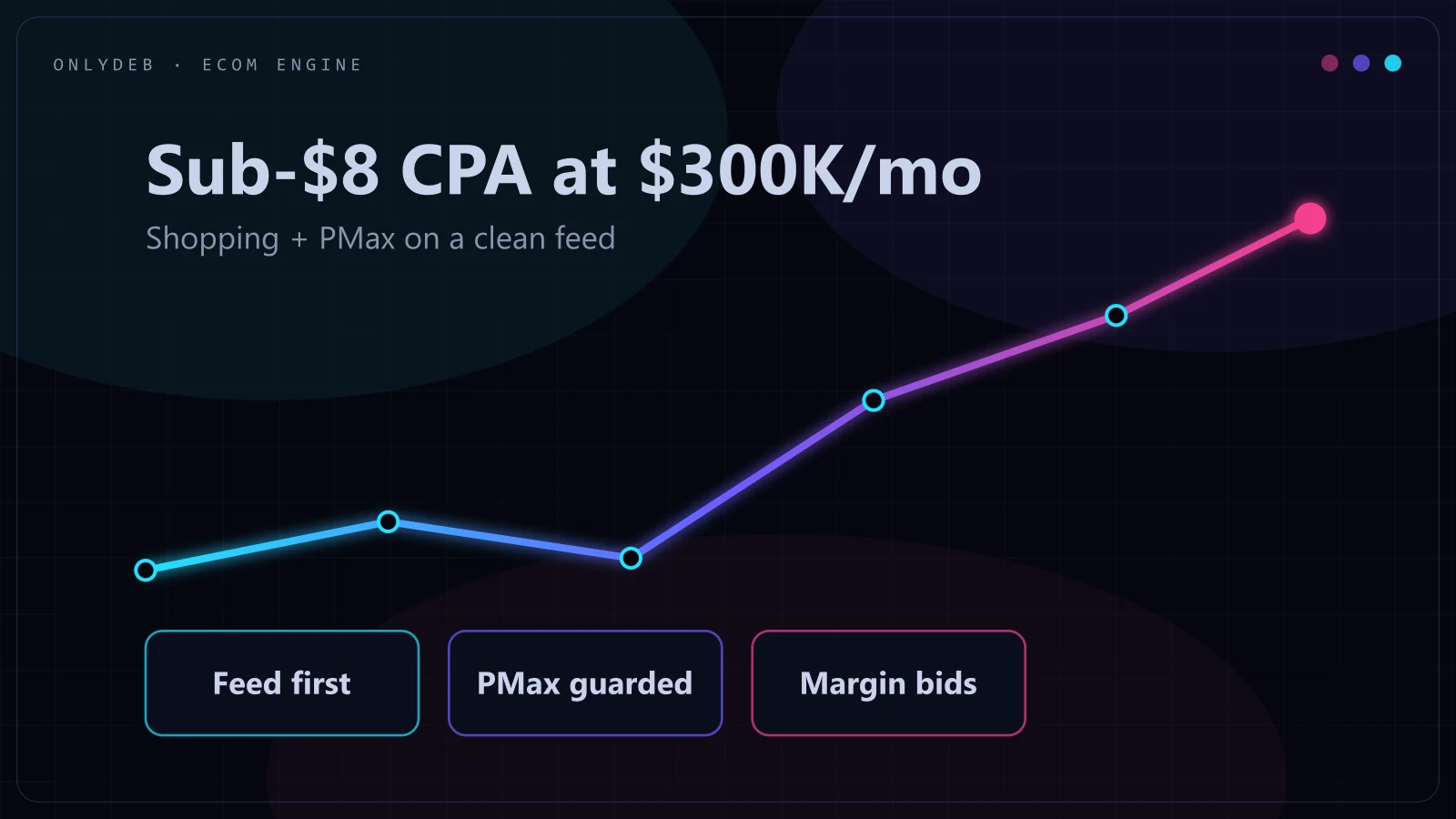
The first thing I did when I took over the Dagamma account, the team behind Baby Doppler, was pull up Merchant Center. Spend was already north of $200K a month and climbing toward $300K, and the account looked healthy from the Google Ads side: impressions steady, clicks flowing, nothing on fire. Then I opened the diagnostics tab and found close to a third of the catalog sitting in disapproved or limited status, quietly bleeding revenue that never showed up as an error anyone was watching for. Nobody had checked feed health in months, because feed health isn't a metric on a dashboard. It's a status that fails silently while the campaigns above it keep spending.
That gap, between an account that looks fine in Google Ads and a feed that's actually broken underneath it, is where most of the money gets lost on ecommerce accounts. Fixing it, alongside a full pass on bidding structure and traffic segmentation, is what eventually got us to a sub-$8 CPA at $300K+ monthly spend, a 400% ROAS, and over $2M in revenue during seasonal peaks. None of that came from a clever new campaign type. It came from treating the parts of the account nobody was watching as the actual campaign.
Google Ads for ecommerce is the discipline of getting product data, bidding strategy, and traffic segmentation all pointed at the same margin target at the same time. A Shopping or Performance Max campaign can only bid well on data that's accurate, and it can only protect profit if the bid strategy is tied to your actual margin instead of a flat revenue goal. Most ecommerce accounts underperform not because the campaign type is wrong, but because one of those three pieces is quietly broken while the other two get all the attention.
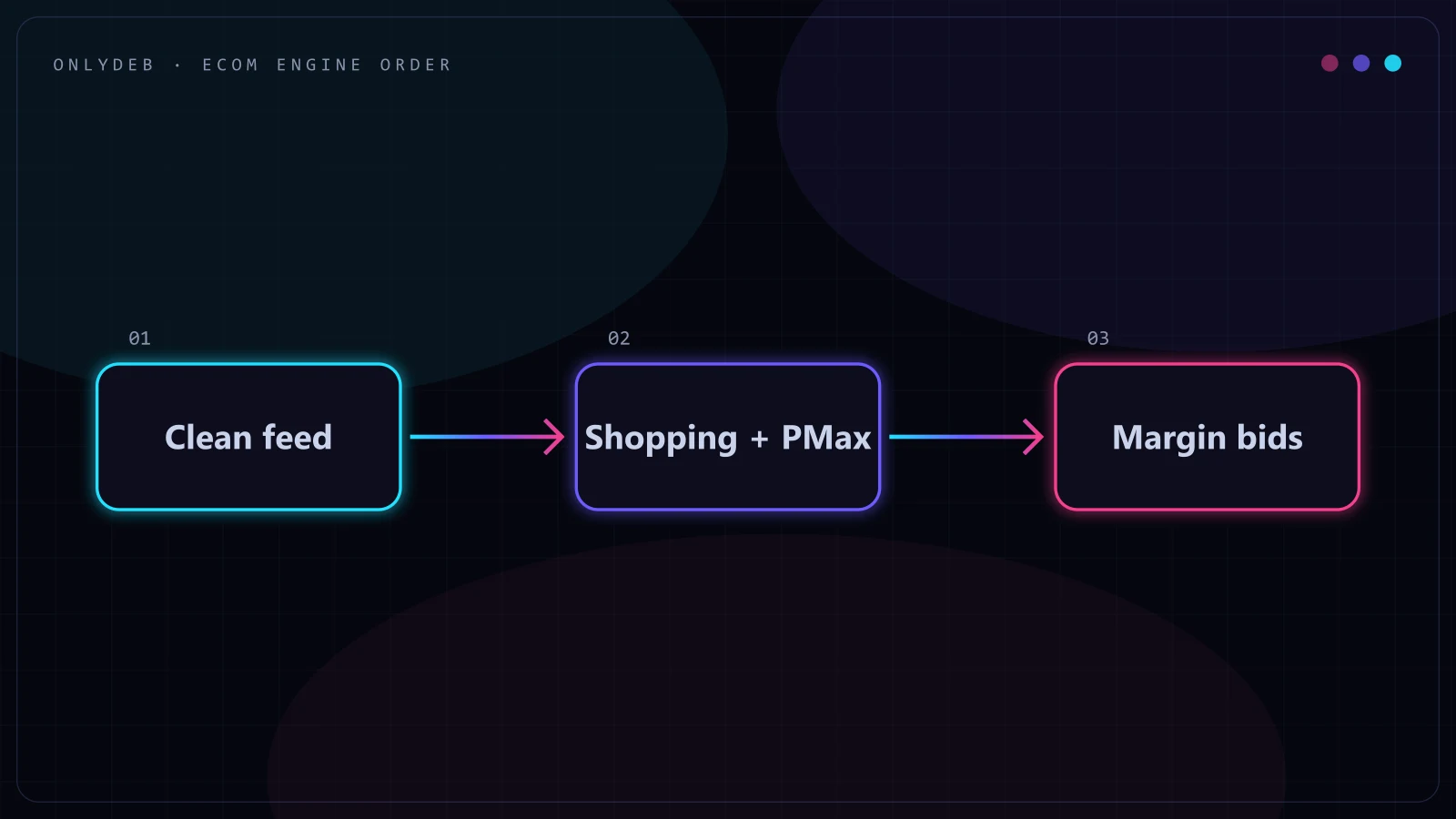
The Product Feed Is the Campaign
Every Shopping ad and every Performance Max product listing is generated from your Merchant Center feed, not from anything you write inside Google Ads. If the feed has a wrong GTIN, a stale price that doesn't match your site, or missing size and color attributes, the ad either gets disapproved, gets shown for the wrong queries, or gets suppressed in the auction without any obvious signal that it happened. On the Black Voyage account, a Shopify luggage brand, part of what took ROAS from 1.69 to 4.26 in under four months was a Merchant Center cleanup done before we touched a single bid.
The habits that matter here are boring on purpose: titles that lead with brand and product type instead of marketing copy, GTINs and MPNs that match the manufacturer's actual data, images that meet Google's size and background requirements, and a price and availability feed that syncs with your site in near real time so you're never advertising something out of stock. It's the single hour that pays off the most on an ecommerce account, because a campaign built on a clean feed starts every other optimization from a real baseline instead of fighting disapprovals you can't see.
On the Mandarin Duck account, an archery gear retailer, the same pattern showed up in reverse: feed and bid optimization together got the account to a 400% ROAS, and neither lever would have gotten there alone. If your product data is unreliable, better bidding just optimizes toward a broken input faster.
Stop guessing with your ad spend.
I build highly profitable Google Ads acquisition systems for ambitious brands. Stop burning cash on broad match and let's scale your ROAS properly.
Shopping vs Performance Max and When Each Earns Budget
Performance Max earns its reputation on incremental reach. It can surface a product to someone browsing YouTube or scrolling Discover who was never going to type a Shopping-style search query. What it doesn't do as well is give you granular, product-level bid control, since its bidding decisions happen inside a machine-learning system you can nudge but not directly steer campaign by campaign.
My default structure keeps a standard Shopping campaign running alongside Performance Max, not instead of it. Shopping handles top sellers and clearly defined margin tiers where I want direct bid control down to the product group level. Performance Max runs on top for incremental reach across the rest of the catalog and other channels. I wrote a full breakdown of that setup in my guide to Performance Max optimization, including the asset group and audience signal choices that keep the incremental side from just cannibalizing Shopping.
The question I ask before shifting budget toward either one is simple: is this campaign earning new demand, or is it just winning auctions on traffic that was going to convert regardless of which campaign served the ad? That question is impossible to answer honestly without the next section.
Branded Traffic Exclusions: Why Blended ROAS Lies
Branded search traffic converts at a high rate almost regardless of what your ad says, because the person searching your brand name already decided to buy from you. If your Shopping and Performance Max campaigns are allowed to serve on branded queries, your blended ROAS looks great, and it's telling you almost nothing about whether your spend is generating new customers or just intercepting people already on their way to your site.
On the Black Voyage rebuild, excluding branded traffic from both Shopping and Performance Max was one of the four changes that moved ROAS from 1.69 to 4.26, alongside the PMax restructure, Shopping segmentation, and Merchant Center cleanup. Once branded exclusions were in place, the reported ROAS on non-branded campaigns dropped at first, because it stopped getting credit for conversions it wasn't actually causing. That's the point. A lower, honest ROAS on non-branded traffic tells you where your actual customer acquisition is happening, and it's the only number worth optimizing against.
The account with the best-looking blended ROAS is often the one that has never separated branded traffic from the rest.
In practice this means a negative keyword list covering brand terms and close misspellings applied to Shopping and standard Search, plus a separate branded campaign to measure that traffic on its own line. Performance Max doesn't accept branded negatives directly, so this usually means a dedicated brand-exclusion list at the account level or careful audience signal management instead.
Margin-Based tROAS Targets
A single flat ROAS target across an entire catalog is one of the more common mistakes I see when I audit an ecommerce account. A product with 55% margin can profitably support a 300% ROAS. A product with 18% margin needs closer to 600% just to break even after ad cost, fulfillment, and returns. If every product in the feed is bidding to the same target ROAS, you're either underbidding on your most profitable items or overspending to hit a target on items that were never going to be profitable at that rate.
The fix is to build custom labels in your feed for margin tiers, high, medium, low, and set target ROAS at the campaign or product-group level to match. It takes an extra hour of feed work up front and changes how the bidding algorithm allocates budget across your catalog for the life of the account. This is also where a conversion rate problem on the site can undermine a well-tuned bidding strategy. If checkout friction or unclear shipping costs are suppressing conversion rate, no amount of margin-tiered bidding fixes that on the ads side. I go through the site-side half of that equation in my guide to improving ecommerce conversion rate.
Seasonal Scaling Without Breaking Learning
Peak season is where ecommerce accounts either compound their best months or blow up their bid strategy chasing them. The instinct going into a peak window is to raise budgets and tighten targets at the same time, and that combination resets a campaign's learning phase at the worst possible moment, right when you need stable bidding the most.
My approach is to scale budget in increments of no more than 20-30% every few days rather than doubling it overnight, and to loosen tROAS targets slightly during the ramp rather than tighten them, since a stricter target on a scaling budget just throttles delivery. I also pull forward any feed and structural changes, margin tiers, branded exclusions, new product launches, well before the peak window starts, so the account isn't relearning bidding signals during the days it needs to spend with confidence. The $2M in seasonal revenue on the Dagamma account happened inside windows planned weeks in advance, not from a last-minute budget increase.
What I Check Weekly on Ecom Accounts
None of the above works as a one-time setup. It works as a weekly habit, and the checklist I run on every ecommerce account I manage stays close to the same five items regardless of catalog size or spend level.
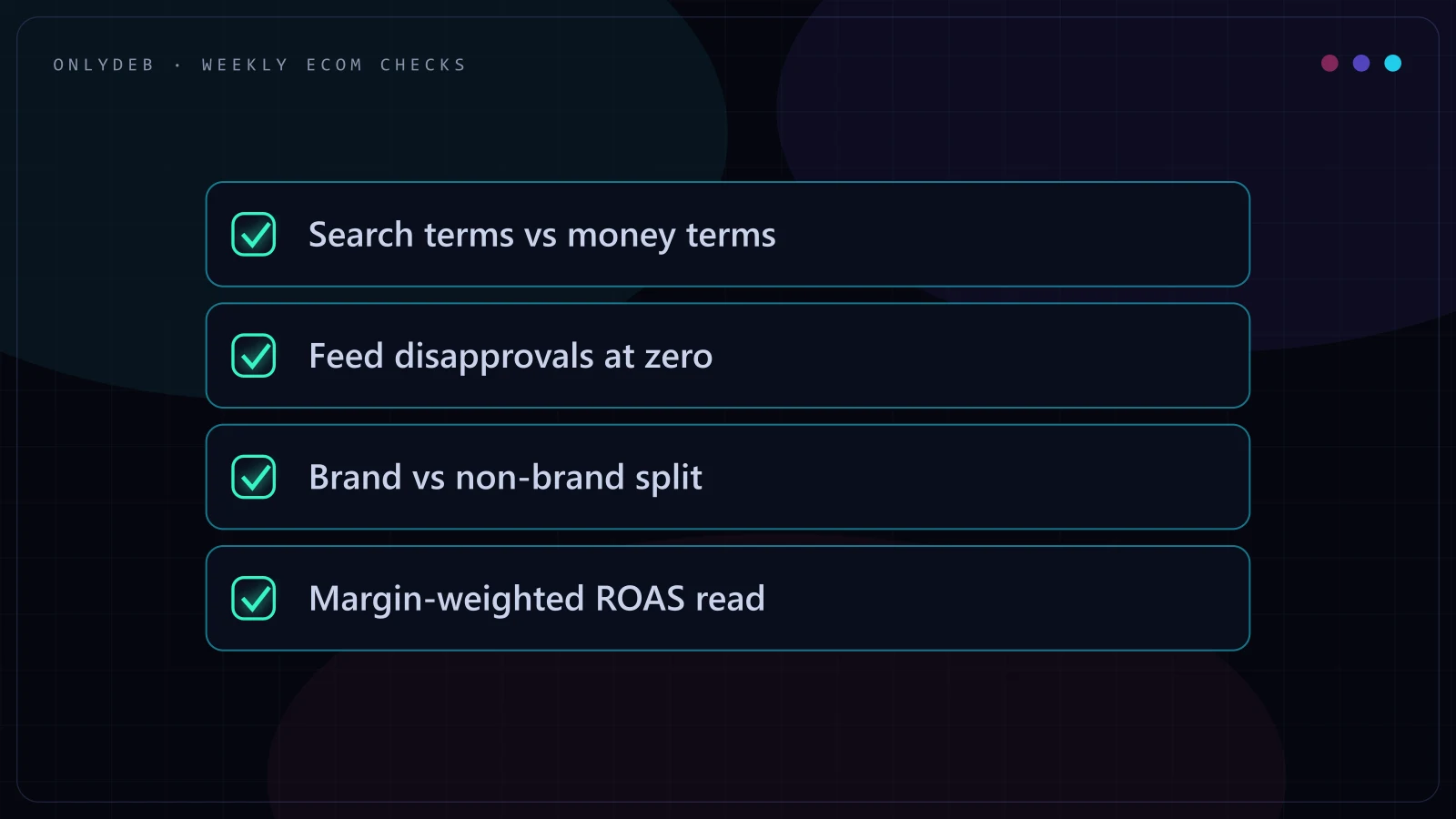
- Merchant Center diagnostics: new disapprovals, limited status items, and any account-level warnings that appeared since the last check.
- Branded vs non-branded split: confirming exclusions are still holding and branded spend isn't leaking back into Shopping or PMax.
- Margin-tier bid performance: whether each custom-label tier is pacing toward its own tROAS target, not a blended average.
- Search term and placement review: for Shopping, new negative candidates; for Performance Max, placement and asset group performance where visible.
- Stock and price sync: spot-checking that Merchant Center still matches the live site, especially after any inventory or pricing change.
Accounts among the ecommerce brands I've worked with tend to have their own wrinkles on top of this list, seasonal catalogs, marketplace sync issues, subscription products, but the five checks above are the floor. Skip them for a month and you'll usually find the same kind of silent problem I found on Dagamma the day I first opened Merchant Center.
FAQ
Is Performance Max enough on its own for ecommerce?
On most accounts I run, no. Performance Max is strong at finding incremental demand across Search, Display, YouTube, and Discover, but it makes weaker moment-to-moment bidding decisions on individual products than a well-segmented standard Shopping campaign can. My default is to run both together: standard Shopping to control bids on top sellers and margin tiers directly, Performance Max layered on top for the incremental reach, with branded traffic excluded from both so neither one gets credit for demand that was already coming.
What is a good ROAS for ecommerce Google Ads?
There is no universal number, because ROAS only means something next to your margin. A 400% ROAS is healthy on a product with 40% margin and break-even on a product with 15% margin. Across the ecommerce accounts I have managed, 400-500% is a realistic annual average once the feed and campaign structure are sound, with a peak of 900% on one account during a strong seasonal window. Anyone quoting you a target without asking about your margin first is guessing.
What is the minimum ad budget for ecommerce Google Ads to work?
Shopping and Performance Max both rely on conversion volume to exit the learning phase and bid well, so an account spending a few hundred dollars a month across dozens of products rarely generates enough signal per SKU. I generally want to see at least 15-30 conversions a month per campaign before I trust the bidding data, which in practice means a few thousand dollars a month as a realistic floor for a catalog of any real size, more if average order value is low.
How long until Shopping campaigns start working?
Expect a 1-2 week learning period after any meaningful structural or bid strategy change, and I tell clients not to judge a new Shopping setup before 3-4 weeks of stable spend. Judging performance in week one, when Google is still figuring out which queries and placements convert, is the single most common reason ecommerce accounts get restructured before they were ever given a fair chance.
Should I hire a feed management agency or manage Merchant Center myself?
It depends on catalog size and how often your product data changes. A small catalog with stable pricing and inventory can be managed in-house with a disciplined weekly check. A large or fast-moving catalog, especially one with frequent price and stock changes, usually benefits from a dedicated feed tool or a manager who treats the feed as core to the account rather than a one-time setup task, since disapprovals and stale attributes compound quietly until spend and revenue both drop.
If your Shopping or Performance Max campaigns are spending steadily but growth has flattened, the feed and the bid strategy are the first two places I'd look before touching creative or targeting. Get in touch and I'll walk through your account with you.