Google Ads Account Suspended? What to Do (From Someone Who Worked Inside Google)
The email arrives with no warning: your account has been suspended, campaigns off, spend frozen. I've sat on the other side of that moment, inside Google, reviewing hundreds of these cases a quarter. Here's what actually happens next, and what I learned about the difference between accounts that come back and accounts that don't.

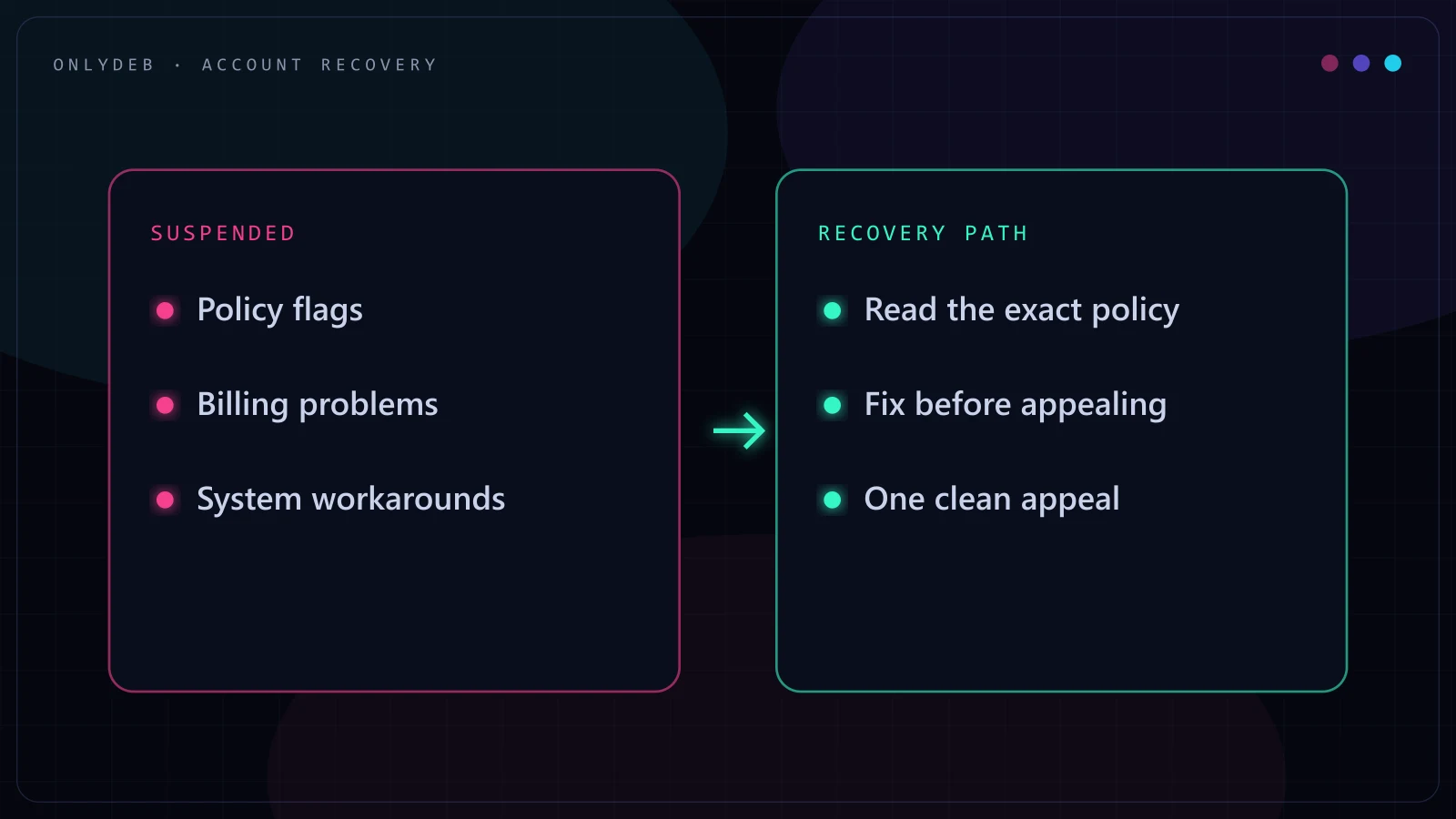
You open your inbox and there it is: "Your Google Ads account has been suspended." No warning, no dip in performance first, just a flat statement and a frozen dashboard. Every campaign paused mid-flight, spend that was driving leads yesterday now producing nothing, and a support system that routes you to a help center article instead of a person. The panic isn't irrational. For a lot of small businesses, that account is the pipeline, and a suspension feels like someone cut the power without saying which breaker to flip back on.
I know that inbox moment from the advertiser side. I've also seen it from the other side of the desk. Between April 2017 and August 2018, I worked as a Senior Associate at Google's Operations Center, individually handling support and account issues across more than 400 Google Ads accounts per quarter for the North American market, with a 100% customer satisfaction score for three consecutive quarters. That doesn't mean I have some backdoor into Google today, I don't, and anyone claiming current insider pull with Google Ads review teams is selling you something. What it does mean: I've watched, case after case, which suspensions were earned, which were honest mistakes, and which advertiser responses made things better versus permanently worse.
A Google Ads account suspension is Google Ads removing an account's ability to serve ads, usually after an automated or manual review flags a policy violation, a billing or payment problem, or activity that looks like an attempt to get around Google's enforcement systems. It is not a warning. It's an enforcement action, and how you respond to it in the first 48 hours matters more than most advertisers realize.
The Suspension Categories That Cover Almost Every Case
Suspension reasons vary in wording, but in practice, nearly every case I worked fell into one of three categories. Knowing which one you're in changes everything about what to do next.
| Category | What it looks like | Common trigger |
|---|---|---|
| Circumventing systems | Behavior designed to get around Google's review or enforcement, including cloaking, ad-serving tricks, or opening duplicate accounts | A prior suspension followed by a new account tied to the same business |
| Billing and payments | Payment method problems, mismatched billing details, or patterns that look suspicious to automated fraud checks | Declined cards, inconsistent business or billing information, unusual payment activity |
| Policy violations | Misrepresentation, prohibited content or practices, or destination sites that don't match what the ads claim | Landing pages that oversell, hide terms, or misstate who's behind the business |
Circumventing systems is the category Google treats most seriously, because it signals an advertiser actively working around enforcement rather than making a mistake within it. Billing and payment issues are, in my experience, the single most common trigger overall, and a lot of them aren't malicious, just messy account hygiene that a fraud system reads as risk. Misrepresentation covers a wide range, from a landing page promising something the business doesn't deliver, to a checkout flow hiding recurring charges, to an about page misstating who owns the business.
Stop guessing with your ad spend.
I build highly profitable Google Ads acquisition systems for ambitious brands. Stop burning cash on broad match and let's scale your ROAS properly.
Why Filing an Appeal Immediately Is Usually the Worst Move
The instinct after a suspension is to hit the appeal button the same hour the email arrives. I understand the urge. Every day the account is down is a day of lost pipeline. But in the cases I saw resolve well versus the ones that stayed suspended for months, the difference almost never came down to speed. It came down to whether the appeal had anything new to tell a reviewer.
An appeal filed the same day as the suspension, before anything was actually fixed, is asking a reviewer to reverse a decision based on nothing more than a promise.
Appeals get reviewed against what actually changed, not against how urgently you need the account back. Appeal within the hour and the underlying billing problem, policy gap, or site issue is still sitting there, and the reviewer sees exactly what triggered the suspension the first time, still present. That appeal gets rejected, and a rejected appeal makes the next one harder, since now there's a pattern of appeals with no corresponding fix. You've used your best shot on the version of the case with the least evidence behind it.
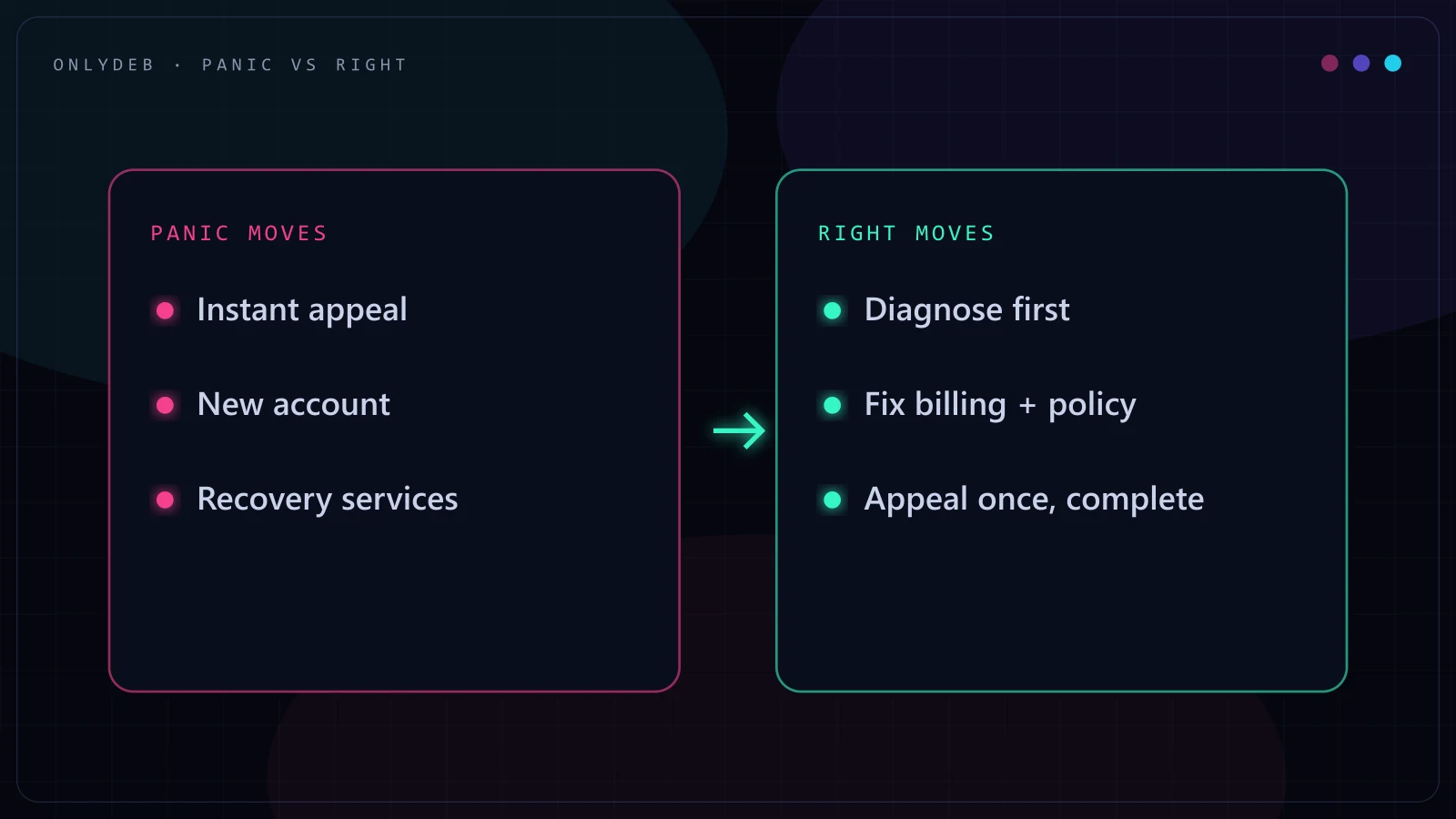
The Sequence That Actually Works: Fix First, Then Appeal
The order matters more than the speed. Before you touch the appeal form, work through this sequence.
- Read the suspension notice literally. It usually names a policy area or issue type. Don't assume you know the reason, read the specific language Google used.
- Diagnose the real cause, not the symptom. For billing, check every field, business name, address, payment method, for consistency across your account and your actual business records. For policy, pull up the exact policy page named in the notice and compare it line by line against your site and ads.
- Fix the underlying issue completely. A landing page misrepresenting the business needs a real rewrite, not a tweak to the one headline that got flagged.
- Document what changed. Screenshots, dates, and a clear before-and-after. Reviewers move faster when evidence is easy to verify.
- Then file the appeal, once there's an actual, verifiable change for a reviewer to evaluate.
What a Clean Appeal Actually Contains
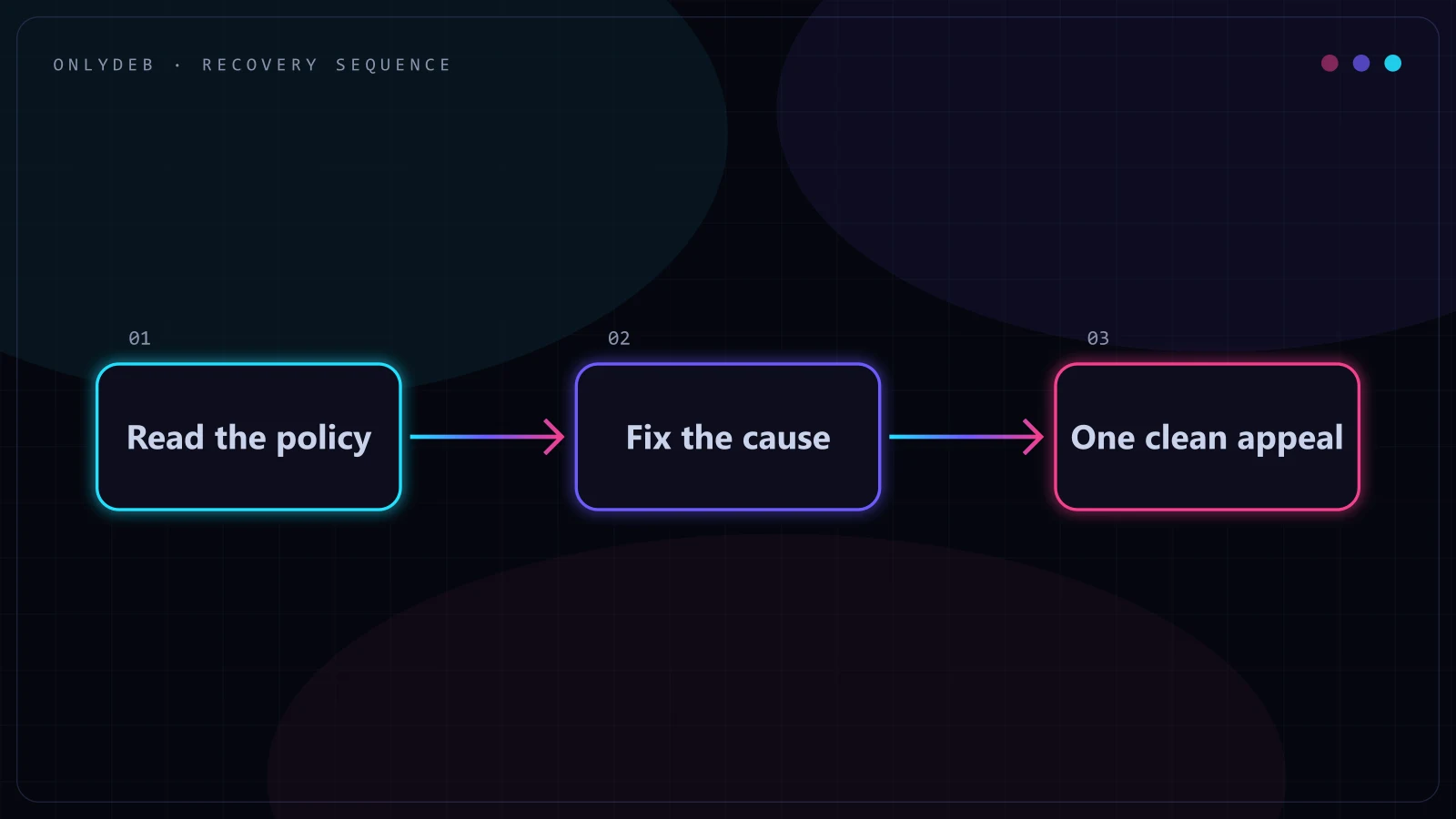
A strong appeal is a short, factual account of three things: what the notice said the problem was, exactly what was fixed and when, and evidence that supports the fix. Reviewers work through high volume, and an appeal that makes their job easy, plain language, specific changes, verifiable evidence, gets a fairer read than one that argues the case emotionally or disputes the policy itself.
If the suspension involved a business practice rather than a technical error, like a misrepresentation issue, the appeal should reflect an actual change in that practice rather than a change in wording alone. Google's official policy pages describe exactly what each violation category covers, and the suspended Google Ads accounts policy page is the accurate, current source for how the appeal process itself works. That page, not a forum thread or a paid "recovery service," is where I'd start before filing anything.
Prevention Matters More Than Recovery
Every case I've seen where an appeal succeeded quickly had one thing in common: the underlying business was legitimate and the issue was fixable. Prevention still beats recovery, since even a successful appeal costs weeks of lost spend. Three habits cut the risk more than anything else I've seen work.
Keep billing information boring and consistent: same business name, same address, same details across your Google Ads account, your website, and your payment method. Inconsistency is one of the fastest ways to trip an automated fraud check even when nothing fraudulent is happening.
Read the actual policy pages for your specific vertical, not a generic summary. Financial services, healthcare, and anything involving personal data carry requirements beyond the general advertising policies, and not knowing a rule applied to your industry doesn't change the enforcement outcome.
Skip the gray-hat tricks entirely: cloaking, redirect chains that show reviewers something different from what users see, or ad copy that promises what the landing page doesn't deliver. These sit squarely inside the circumventing-systems category, and once an account carries that flag, every future review starts from suspicion. If your account structure or tracking setup hasn't had a real look in a while, a straightforward Google Ads audit will surface the same inconsistencies that trigger suspensions, before Google finds them for you.
Genuinely Unfair vs Genuinely Earned
Not every suspension is deserved. Automated enforcement occasionally flags legitimate advertisers over a false-positive billing signal, a false match in a policy scan, or a linked account sharing a network or device with an unrelated bad actor. Those cases are real, and the appeal process exists partly for them. But in my experience, the honestly-unfair cases are a minority. Most trace back to something concrete: a billing inconsistency, a landing page that oversells, or a practice that crossed a line the advertiser didn't read closely. The useful exercise is checking whether the exact issue named in the notice is actually present in your account right now, rather than debating how fair the rule feels. Worried about the whole managed account rather than a single suspension in progress? That's a broader conversation about who's watching it day to day, covered in my guide to hiring a Google Ads expert.
Field kit · Free download
The Suspension Survival Kit (one-page PDF)
The don'ts, the sequence, and the appeal checklist from this guide, on a single page you can keep next to the account.
FAQ
How long does a Google Ads suspension appeal take?
There's no fixed timeline, and anyone who promises you an exact number of days is guessing. Review times vary by suspension type, how clear the underlying issue is, and current review volume. A straightforward billing fix can resolve faster than a policy violation tied to the business model itself. Expect the process to take real time and plan around that, rather than around a promise.
Can I just open a new Google Ads account instead of appealing?
No. Opening a new account to get around a suspension is itself a form of circumventing systems, which is one of the suspension categories in the first place. Google links accounts through business details, billing information, website domains, and device and network signals, so a new account tied to the same business tends to get suspended too, often faster the second time. It also removes any chance of getting the original account back.
Do Google Ads account recovery services actually work?
Be skeptical of anyone who guarantees reinstatement for a fee. Nobody outside Google's review team controls the outcome of an appeal, and a legitimate suspension can't be paid around. What a knowledgeable person can genuinely help with is diagnosing the real cause, fixing the underlying issue correctly, and writing an appeal that gives a reviewer what they actually need to make a decision. That's different from a guarantee, and anyone offering the guarantee is the one to walk away from.
What is the most common reason Google Ads accounts get suspended?
In my experience handling these cases, billing and payment issues, like a declined card, a mismatch between billing details and account information, or unusual payment patterns, come up constantly, often more than deliberate policy violations. It doesn't always mean bad intent. Plenty of legitimate advertisers get flagged because their billing information looked inconsistent to an automated system, which is exactly why billing hygiene matters as much as ad content.
Can a Google Ads manager help prevent account suspensions?
A manager who reads the policy pages for your specific vertical, keeps billing and business information consistent, and avoids gray-hat tactics reduces suspension risk significantly, but nobody can guarantee an account never gets flagged. Automated enforcement sometimes catches accounts that did nothing wrong. What a good manager adds is fewer avoidable mistakes on the front end, and a calmer, better-documented response if something does go wrong.
A suspension isn't the end of the account, but it does need a clear head and the right sequence, fix first, document, then appeal, not the other way around. If you're sitting with a suspended account right now and want a second set of eyes on the notice before you file anything, get in touch and let's look at it together.