What 400 Accounts a Quarter Inside Google Taught Me About Running Ads
In 2017 and 2018, I was a Senior Associate at Google's Operations Center, individually supporting 400+ advertiser accounts a quarter for the North American market, with a 100% CSAT score across three straight quarters. Here is what that seat taught me, and how it shows up in the way I run accounts today.

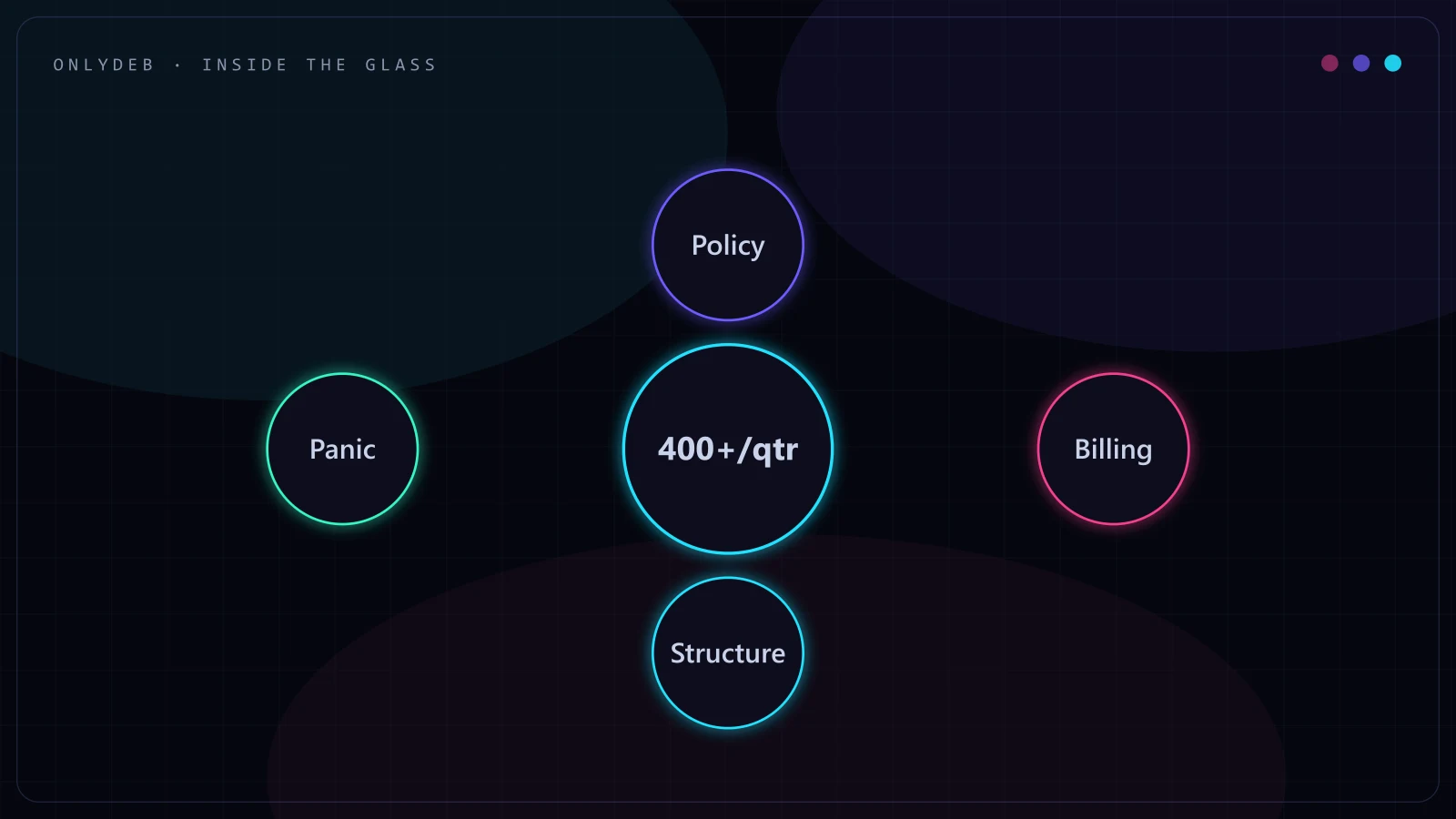
Before I ever managed a Google Ads account for a client, I spent a stretch on the other side of the phone and the support ticket. From 2017 to 2018, I worked as a Senior Associate at Google's Operations Center, individually supporting more than 400 advertiser accounts a quarter for the North American market, and held a 100% customer satisfaction score across three consecutive quarters. That is a real, checkable fact about my background, not a claim about anything confidential I saw while there.
Google Ads support, at a high level, is the frontline team that helps advertisers with account access, billing, policy disapprovals, technical issues, and general how-does-this-work questions, separate from and different from paid or fractional account management. A rep in that seat isn't strategizing your bids or writing your ad copy. They are triaging what is actually broken, explaining policy, and routing anything that needs deeper review to whoever owns that process. Understanding that distinction on its own would have saved a lot of advertisers a lot of frustration, and it's the first thing I try to explain to clients now.
Four Hundred Accounts a Quarter Teaches You What Normal Looks Like
Most advertisers have exactly one Google Ads account to compare against: their own. They don't know if their click-through rate is fine or alarming, if their disapproval rate is typical, or if the panic they feel over a sudden cost spike is warranted or completely routine. When you're individually handling hundreds of accounts a quarter, that uncertainty disappears fast. You start to see the actual range of normal: how often accounts get flagged for review, how long a genuine fix takes versus a manufactured emergency, which billing issues resolve themselves in a day and which ones need real attention.
That volume is the single biggest thing I can't get back now that I run my own book of clients, and it's also the thing I lean on the most. When a client messages me convinced their account is uniquely broken, I usually already know whether that's true, because I've seen the pattern play out across accounts that had nothing else in common with theirs.
Most Emergencies Were Preventable Weeks Earlier
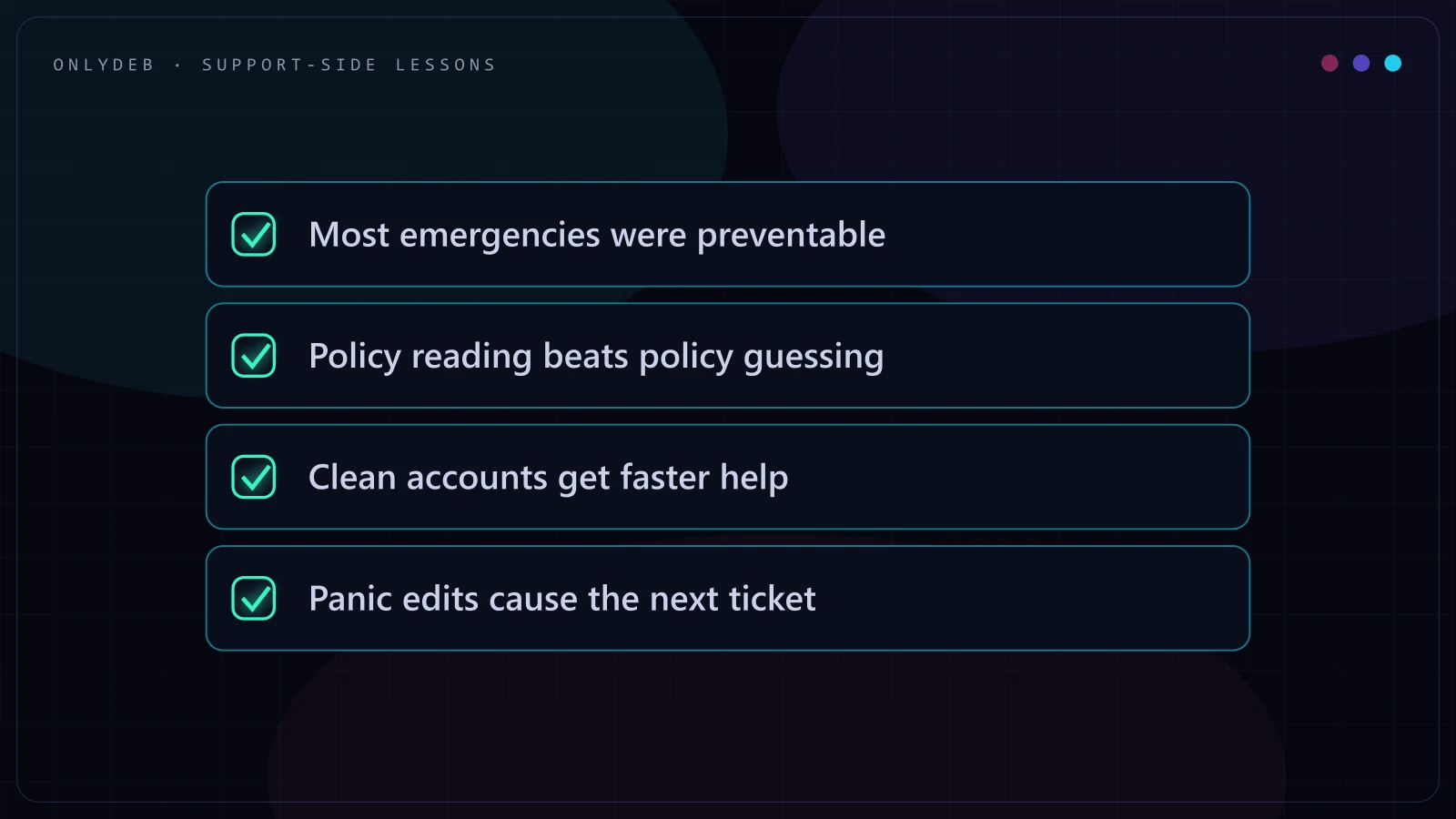
A striking share of the tickets that came in as urgent weren't actually sudden. A payment method that was going to fail had been flagged in the account for weeks before it finally did. A policy violation that shut off a campaign was written into Google's public policies well before the ad ever ran. The emergency wasn't the event, it was the advertiser finding out about something that had been true and visible for a while.
Billing hygiene and a basic habit of reading policy updates would have caught almost all of it earlier, at a point where fixing it was a five-minute task instead of a lost week of ad delivery. That's not a criticism of the advertisers who got caught out. Most of them were running a business, not studying advertising policy for fun. But it's why account suspensions and disapprovals are rarely as random as they feel in the moment, and why I wrote a separate, detailed guide on what to actually do if your account gets suspended, based on the same fix-first-then-appeal sequence I saw work over and over.
The Accounts That Got Help Fastest Were the Clean Ones
There was a clear, repeatable pattern in which accounts got resolved quickly and which ones dragged. An account with clear campaign naming, a change history you could actually follow, and conversion tracking that made sense got a faster, better answer almost every time. An account that was a tangle of undocumented edits, duplicate campaigns, and no clear record of who changed what took longer, because a rep had to spend time reconstructing the story before they could even start solving the problem.
Structure isn't just an internal nicety for your own reporting. It's a communication tool between you and anyone else who ever has to look at the account, whether that's a support rep, a new hire, or a freelancer you bring in six months from now. An account that explains itself gets better outcomes from every person who touches it.
Panic Edits Write the Next Support Ticket
One of the clearest patterns I saw: an advertiser panics over a metric moving the wrong way, makes a fast, unplanned change to fix it right then, and that change is what generates the next ticket. Pausing every keyword with a high cost, slashing a budget mid-day, switching bid strategies because yesterday looked bad, these moves almost never solve the underlying issue, and they frequently create a new one, like a bid strategy that has to relearn from scratch or a campaign that goes dark at the exact wrong moment.
The accounts that avoided this cycle had someone attached to them who could sit with a bad day of data without reacting to it inside the same hour. That's a discipline, not a personality trait, and it's one of the harder things to hand off to a client who is watching their own ad spend in real time.
What Advertisers Assumed About Support, and What Support Actually Saw
Most advertisers pictured support as a single person who could see everything about their account and fix anything on request. The operational reality is closer to a queue system with escalation paths and logged case histories: a rep working a case has access to what's documented, follows a defined path for what can be resolved directly versus what needs to move to a specialized team, and every interaction is recorded so the next person who picks up the case isn't starting blind. None of that is secret information, it's just not visible from the advertiser's side of the interface, which is exactly why the gap in expectations exists.
That gap, more than any single ticket, is what made me want to move to the advertiser's side of the table. Support can fix what's broken and explain policy, but it can't run your strategy, and it was never supposed to. Watching how much value got left on the table simply because advertisers didn't know where that line was is part of what led me into managing accounts directly instead. There's a related, wider conversation about what information actually does and doesn't make it out to advertisers in my post on what actually leaks out of Google Ads accounts, if you want the fuller picture.
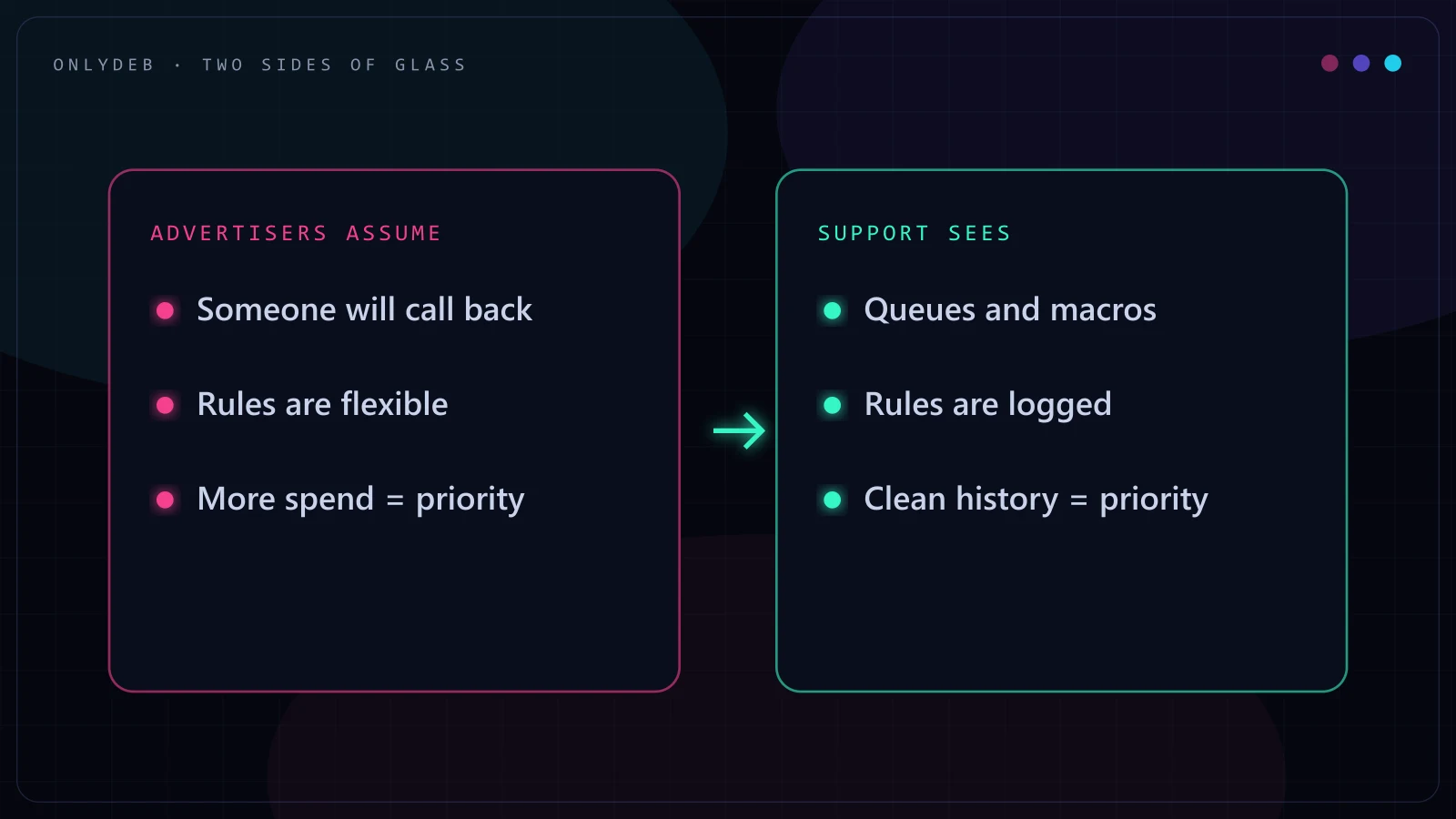
The advertisers who got the best outcomes weren't the ones who knew the most people. They were the ones whose accounts explained themselves.
Stop guessing with your ad spend.
I build highly profitable Google Ads acquisition systems for ambitious brands. Stop burning cash on broad match and let's scale your ROAS properly.
How Each Lesson Shows Up in My Practice Now
None of this stayed theoretical once I started managing accounts myself. Every client keeps their own account access, full stop, because I saw what it costs an advertiser to be locked out of their own data when a relationship ends badly. Every meaningful change gets documented, with a reason attached, not just a timestamp, because I know exactly how much faster problems get solved when the history is legible. Policy gets checked before creatives ship rather than after they get flagged, because the fastest fix is always the one you never needed.
I also try not to forget what it felt like from the other side of a support queue: the advertiser wasn't being difficult, they were scared, and most of the fear came from not knowing what was normal. That's still the most useful thing that seat gave me, more than any specific process detail. It's the reason I try to explain what's happening in a client's account in plain terms, before they have to ask, instead of waiting for them to reach the point of panic that used to land on my desk.
For a full walk-through on the mechanics of getting a flagged or suspended account back in good standing, official guidance is also worth reading straight from the source at Google Ads Help, alongside whatever a manager or freelancer tells you.
FAQ
Does knowing someone at Google help you get better Google Ads support?
No. Support tickets move through the same process regardless of who you know, and there is no side channel that skips a queue or waives a policy. What actually helps is understanding how the process works: what information a rep needs, what gets escalated versus resolved on first contact, and how to document a case so it does not need to be re-explained three times.
Does Google Ads support optimize your account for you?
No, and this is one of the more common misunderstandings. Support answers policy questions, fixes account-level issues, and helps with billing, disapprovals, and technical problems. It is not account management, and reps are not sitting there adjusting your bids or restructuring your campaigns. That work is either yours to do or a manager's job, not support's.
Why do Google Ads reps keep suggesting the same recommendations?
A lot of guidance points toward the Recommendations tab and optimization score because it is the standardized, defensible answer for a huge range of accounts, and it is genuinely useful for accounts that have never been touched by anyone with real PPC judgment. The problem is that a standardized suggestion does not know your margins, your seasonality, or your actual goal, so it is a starting point, not an instruction.
Is everything in the Recommendations tab worth applying?
Some of it. Recommendations that tighten conversion tracking gaps or clean up obvious structural issues are usually worth a look. Recommendations that add broad keywords, raise budgets, or push you toward automated formats faster than you'd choose on your own deserve more scrutiny, since the tab's optimization score rewards adoption, not necessarily your account's bottom line.
How do you get a better outcome when you contact Google Ads support?
Write the issue down clearly before you contact anyone: what changed, when, what error or symptom you are seeing, and what you have already tried. Stick with one case and one thread instead of opening a new one each time you get impatient. A clean, well-documented account with a real change history gets resolved faster than a messy one, because the rep spends less time reconstructing what happened and more time actually fixing it.
I spent a year and a half on the other side of this relationship, and I've spent the years since applying what it taught me on behalf of clients instead of Google. If you want an account run by someone who has seen what both sides of that queue actually look like, let's talk about your account.